Monday, March 30, 2026

Acquainted with grief

Madonna and child statue c. 1450, St.Marien Wallfahrtskirche Ziegelheim

A bottle of Bell's Amber Ale in my right hand, a fistful of tortilla chips in my left, I sit down and reach for the laptop to write something in which I contemplate Holy Week. Or contemplate something. 

Easter's on the early side this year, and the weather has been wandering back and forth from promise-of-spring temperatures to so-cold-for-March. Some days the sun shines brightly, but never all day, never for long. The tulips in the yard are far enough along for the rabbits to nibble the tips off the leaves. The forsythia are blooming, sprays of yellow flowers that float above the ground which is still blanketed with last fall's leaves. One hard rainstorm and the forsythia will be done for this year.

Do I need greenery, deciduous greenery? The bare shapes of the maples and oaks and all the others are interesting aesthetically, but all they seem to say to souls is, this is it for the moment. Hold on, keep waiting. We may -- may -- deliver again this year.

Grief caught me in morning worship today. And as it happens, it was a hymn that did it: "The Tree of Life," the text that begins "There in God's garden/stands the Tree of Wisdom." I quote it here so that you do not confuse it with many other "tree of life" hymns. The text, a little unconventional, is from Hungary in the early 1600s, now with a paraphrased translation by Eric Routley. (Read it here.) 

Stanza four ends: 

Hear what the Voice says, "Come to me, ye weary!
Give me your sickness, give me all your sorrow,
I will give blessing."

Stanza five begins: 

This is my ending, this my resurrection;
into your hands, Lord, I commit my spirit.

At age 20, or 30, or even 40, I didn't know—perhaps wouldn't have believed—that grief can fill up a whole hollowed-out body. I may have seen people act this on the stage—MacDuff receiving the news that his wife and children had been slaughtered, or some histrionics in a more modern play. But that was acting, and I turned quickly away from such hard emotions. I didn't know that grief, for real, can suddenly collapse your gut and take away your breath and you need to put your hand on the wall or the table or the back of a chair until your diaphragm relaxes and again draws air into your lungs.

That happens to you and you always remember it. In fact, it catches you and happens again and again. Hard lump in the throat, eyes filling with tears, no breath. You stop singing or walking or working or whatever you're doing and feel the feeling. You feel the gaping absence of what or who you've lost, and your own gaping presence, still here, living with emptiness. 

It was one of those moments that caught me this morning. I paused to feel it and to respect it. And to call up the sweet-sad memories of the dead, the missing. 

But stanza six of the hymn arrangement called for a soprano descant. I've learned in the past ten or twenty years how to recover and keep singing. To open again, breathe again, seriously, playfully, joyfully. Amen. 

In much of my life I've tended to spend Holy Week looking forward to Easter. Maybe this is because I've almost always been singing in church choirs and even as the choir is singing sad and solemn tunes at Maundy Thursday and Good Friday services, it's also rehearsing bright D-major music for Easter Sunday. But also, temperamentally, I lean toward comedy--the plays that turn out well, the novels where all the girls get married in the end, Shakespeare's "The Winter's Tale," where, after repentance and tribulation, the kingdom, sadder but wiser, is restored.

But in me, in my body, that gut-strike of grief lives on, recording the truth of the utter shittiness of a world where things regularly go wrong and so little can be counted on to go right. So much is encompassed in the rounded vowels of sorrow. Here at the beginning of Holy Week 2026, what I see when I look at the black outlines of the trees against the heavy grey sky is Christ on the cross, in pain, alone, suffocating, suffering. 

And I know that God gets it. The giant gut-punch of all that's wrong with the world. 


Sunday, February 22, 2026

Twenty years of making a blog

I came to a point in the middle of my knitting last night where the pattern in the row I was knitting was not matching up with the pattern two rows below. It's lace; the pattern is the whole point. The group of five plain stitches in the row I was knitting had to be centered on a group of three stitches below it, but that group of three had somehow turned into five, with holes intentionally made by yarnovers falling in the wrong places. As I studied the work in front of me I saw that midway through a previous row my eyes had slipped down to the wrong row on the chart and there was much more that was wrong than just a few stitches. I remembered that the previous right-side row had ended with only half a repeat of the pattern. Now I knew why. 

There was no easy remedy. Some knitting mistakes can be fixed with just a five or ten-minute digression. To fix this one I was going to need to rip out two rows, which doesn't sound that bad -- except that each row currently holds approximately 350 stitches long. The silk yarn is slippery as a guppy in a fish tank, and the pattern is complicated, so they have to be taken out one by one. When a stitch slips away from me  I have to grab it fast and then solve the puzzle of how to bring it back into the pattern. 

Mistakes and correcting them. Isn't that a lot like life? 

I've long had a rule for myself about mistakes in knitting or sewing: you don't have to fix them before you put the project down and go to bed, but you do have to rip out the mistake so that when you next pick up the work you can go forward rather than back. This has kept messed-up projects from spending an indefinite amount of time tossed into a corner or abandoned altogether. I don't like to get up in the morning and look at what went so wrong the night before. Late last night however I put the knitting down with a couple hundred stitches left to rip out and a long, twisty strand of yarn lying on the couch cushion. It's full of static electricity; it's not going anywhere. 

I am a maker. Not in the larger economic sense of job-creator, business person, technology innovator, youthful start-up entrepreneur, etc. Just in the humble sense of always being in the middle of making something: shawls, sweaters, socks, quilts, handwoven dish towels, occasionally even a meal. We are a category of people, we makers. I am more likely to give you something I've made if you, too, make things, because I know you'll appreciate it. 

I started this blog on February 26, 2006 -- twenty years ago. I was at a point in life where I was waiting to see what was next. I had sent one child off to college the previous fall; the other two would soon be in high school. My husband was in a nursing home with late-stage dementia. Transitions all around. What do I do while I'm waiting? I make something.

Writing is a kind of making, working with words, information and images to create something where there once was nothing. Fixing mistakes is easier on a screen than in real life, easier even than rearranging quilt blocks. The finished project? Here at The Perverse Lutheran it's often some kind of discovery: a new idea, grace, endurance. It seems to me that I found those things more readily twenty years ago or ten years ago when much of the light shining in The Perverse Lutheran came from Gronks Finding Grace, my son Kris's blog about his journey through ALS. 

In 2026 it feels harder to make a path through the weeds, harder to find the clearing. It's a much noisier world. Empathy is overextended; cynicism is easy. I'm tired, I say to myself. I'm overwhelmed. I start blog posts hoping to figure something out but then abandon them.

I'll pick up the silk shawl tonight. I'll finish pulling out those stitches and then reknit them. And tomorrow, maybe, the quilt blocks spread on my dining room table made of print fabric purchased years ago will be joined together with a teal blue solid purchased yesterday. 

It's good to be making things instead of being pushed around by tides and time. I hope that making blog posts, too, continues to be a good thing, putting words together to make small islands of grace and light. 


FROM THE ARCHIVE

"Shining"  from ten years ago. I think "Do the Next Thing" would also be a good title.

A Lenten Prayer from 2006.

Sunday, January 18, 2026

Zero sum?

No fear -- this is Gwen writing, not an AI experiment like a couple weeks ago. Although Google has offered to help me with this blog, to find keywords and add links to them and/or to add image previews, I am rejecting that AI-powered assistance. I suppose that accepting Google's help would push me higher up in the algorithm, wherever that lives, but I'd rather not see my sentences, however they turn out, littered with underlined words in colored type and links that bear no connection to my thinking. There are links in what follows, but I put them there myself and there's no need to click on them.

First thing I read this morning was this: Zero-sum economics keeps failing, a Substack post by econ blogger Noah Smith, who on Substack is called Noahpinion. He wrote something recently that led me to click the subscribe button, and now I get an email from him two or three times a week. The full text of his posts is in the email -- he's not making money off me. I blame Paul Krugman, one of the few Substack accounts I do pay for, though again, most of his posts are mostly free. Back when Krugman wrote for the New York Times I read hime regularly because he, a Nobel Laureate in economics, had the gift of being able to explain macro- and microeconomics in ordinary language. This quality, nothing to sneeze at, is my intellectual love language. 

This morning Noahpinion's post used empirical data, displayed in graphs and tables, to demonstrate that immigration is good (i.e., on the whole, doesn't take jobs from citizens) and tariffs are bad (i.e., they don't create manufacturing jobs in America). Taking stuff away from some people it turns out does not increase the good or goods that others get to own and enjoy. Pluses and take-aways don't zero out everywhere as they might in algebra. 

(Simple math is predictive in other places, like when counting threads in dents and heddles on harnesses on a loom. I consulted the calculator on my phone multiple times yesterday afternoon. As well as Alexa -- give her a math problem and she's back with an answer in seconds. You do need to write down what she says. There's still a market for pens and sticky notes.)

The failures of zero-sum economics made for a great kick-off for a Sunday in Epiphany. As the kingdom of God is revealed in Jesus, zero-sum economics and everything else are turned upside down, inside out, and refuted, at least on a metaphysical level. I'm pretty sure I heard this expressed in a sermon as anti-zero-sum thinking at some point in the past. All the way back during Reaganomics? Or after a financial crisis in the early oughts? I know it echoed through all that hope and change we saw on the horizon when Barack Obama was president. 

The thing is, it's true. Not just in religion but in the real world. Big picture, many things get even bigger and more generous as we all participate in them. We're not dividing a pie, we're sharing an expanding one. This is so much better than learning to live with less all around when the pie contracts because of circumstances or selfishness or bad policy. Or than some of us living with a lot less while others enjoy a lot more. (I'll leave it to Substack economists to pursue this theory into dealing with the federal deficit.)

I heard the refutation of zero-summing in the Old Testament lesson in church this morning, as Isaiah offered a bigger, more expansive vision:

 “It is too light a thing that you should be my servant
  to raise up the tribes of Jacob
  and to restore the survivors of Israel;
 I will give you as a light to the nations,
  that my salvation may reach to the end of the earth.”  (Isaiah 49:6)

And I heard it again this afternoon in a Bach Cantata, Alles nur nach Gottes willen (BWV 72). In English that would be "Everything according to God's will alone." 

I stopped to think about it during the sermon. All is God's good will. I'm not always persuaded of this. I mean, some things absolutely suck and if that's God will, I'm on the losing end. How do I see beyond that?

"Alles, alles" -- "all, all" -- are the words that echo through the cantata's opening chorus. Singers are handed notes --  a sudden D-sharp, an unlikely B-flat -- that leave you with no idea of where the harmony is headed. Ha, ha, Herr Bach -- is God's will capricious? It felt that way, struggling to learn this chorus in just two rehearsals. Or is Bach telling us who we are, adrift, not knowing where things are headed and that God's will is more than we can understand, beyond the numbers we enter into an algebraic equation or the clicks that feed a social media algorithm? How did this all feel to the people in the pews in the 18th century, when the Leipzig occasionally had to worry about invading Turks and all the ordinary maladies that killed infants and small children?

I don't know. This year, 2026, is already a turbulent one, with a federal ICE agent murdering a mother of three in Minnesota and the rest of them rampaging on, bullying immigrants and wine moms in communities where citizens and non-citizens try to live together in peace. Where the president of the United States wants to take Greenland away from Denmark. 

Perhaps I, bruised by life, should shrug my shoulders and acknowledge that this is a world where the strong inevitably consume the weak. But somewhere in my Lutheran education or a lifetime of churchgoing, in some reading about the Kingdom of God or in a light-dawning recitation of the Lord's Prayer, something took root. When I see charts and diagrams that show zero-sum thinking fails to explain the way the economic world is working, I smile and praise God. 

10 dents per inch in a 22-inch reed equals 220. Sleyed 2 threads per dent with 28.5 empty dents.  That's 383 warp threads wound and soon to be threaded in 11 repeats of 32 threads plus 1 for balance and 15 threads either side for straight-draw selvages. It's math now, it'll be cloth someday soon.  

Tuesday, December 30, 2025

NOT by me -- an LLM experiment


I was reading a thread about how writers and college writing instructors can detect text that comes from LLMs -- Large Language Models, i.e. AI. So for an experiment I have ChatGPT the following prompt: 

Write a New Year's Day blogpost in the style of the perverse lutheran.blogspot.com. Dismiss the idea of New Year resolutions and instead write about reliance on God's will. Use imagery from anti-Trump folks and the gospel of Matthew.

Here's what it came up with. What do you think? (I'll tell you what I think at the end.)


January 1 arrives like a reset button everyone insists on pressing too hard. Gym memberships bloom, planners open with a crackle of ambition, and the secular liturgy of “new year, new you” is chanted as if enough willpower might finally save us. It’s all very earnest. It’s also mostly bunk.

The trouble with New Year’s resolutions isn’t that they aim too low. It’s that they aim in the wrong direction. They assume the universe is waiting for us to get organized, that history will finally straighten itself out if we stop eating bread or start waking up at 5:30 a.m. They baptize self-improvement and call it hope.

Meanwhile, outside the sanctuary of self-help, the streets are still full. Cardboard signs sag in the cold. Pink hats are stuffed back into closets but not forgotten. The chants echo anyway—against cruelty, against lies, against the cheap salvation of strongmen and red hats promising glory. Anti-Trump folks know something the resolution-makers forget: the world is not fixed by better habits alone. Something deeper is wrong, and something deeper is required.

Matthew’s Gospel does not begin with a to-do list. It begins with a genealogy—messy, compromised, full of people who did not keep their resolutions and were never asked to. It moves quickly to a baby born under empire, to refugees fleeing violence, to a voice crying in the wilderness, “Repent.” Not: optimize. Not: resolve. Repent. Turn. Be re-oriented.

Jesus in Matthew does not say, “Blessed are those who finally get their act together.” He says, “Blessed are the poor in spirit,” the mourners, the meek, the ones who know they are not in control. He tells us not to worry about tomorrow, not because tomorrow will be fine, but because worrying is a lousy god. “Your heavenly Father knows what you need.” That is not advice for productivity; it is a confession of dependence.

New Year’s resolutions are a small, private Tower of Babel—our annual attempt to climb our way into a better future by stacking days and habits just right. And like Babel, they assume God is impressed by height. Matthew’s Gospel suggests God is impressed by mercy. By bread broken and shared. By enemies loved. By lilies that do not hustle.

So on this New Year’s Day, skip the resolutions. They will forgive you; they always do. Instead, stand still long enough to hear the quieter word: “Follow me.” Not after you improve. Not once you’ve figured it out. Follow—into uncertainty, into protest and prayer, into a world still aching under bad rulers and worse idols.

The year will unfold whether we resolve or not. Empires will strut. Crowds will gather. Signs will be lifted. And somewhere in the middle of it all, Christ will be where Matthew always finds him: not crowning our plans, but interrupting them. Not endorsing our willpower, but undoing it with grace.

That, inconveniently and perversely enough, is good news.


What I think: 

It doesn't sound like me or my writing at The Perverse Lutheran. It lacks the wandering, wondering quality of me starting out and not knowing where I'm going to end up. It's a little too tight. 

Certainly pulls in biblical imagery and mixes it up with anti-Trump political images. Maybe too glibly. I do like the idea of New Year's resolutions being "a small, private Tower of Babel." I wonder if ChatGPT stole that from another blog or sermon published online. Actually I think a lot of what I thought at first was pretty good is a regurgitated mix from human writers. Might even be traceable through search engines. 

But -- I've heard many less coherent sermons. 


Wednesday, December 24, 2025

Celebrating

Last night while carrying out the garbage, I thought about celebrating a pagan Christmas. The walk from the backdoor to the garbage carts in the alley took me past the blue lights woven through the grapevine on my fence. Like most Christmas lights these days, they're LEDs and quite bright, a fiery gas-burner blue. 

And quite tasteful, if I do say so myself. 

Over on the next block, there's a celebration of electric Christmas lighting going on, spreading from house to house with trees wrapped in red and white and arches of light over the sidewalk. "Too much," some would say, shaking their heads, because what do we live for (to paraphrase Mr. Bennet), but to judge our neighbors? 

So go ahead and judge me: I did some serious binging of Hallmark-style Christmas movies earlier this month. Enough to get knit one complicated cabled and three colorwork hats knitted, Christmas gifts all. You need a movie you can watch with only half your mind so that you can keep one eye on the pattern chart. These generic Christmas romances (and there are dozens of them on Netflix) feature very circumscribed Christmas celebrations. "What's your favorite family tradition?" one lead actor will ask the other as they discover one another's better self. The answer invariably involves snow or hot cocoa, family, and a special Christmas tree ornament. But sadly, these things have been inexplicably lost although there's a hint that they might -- just might! -- return at the movie's end. 

I learned while growing up that this sort of sentimental Christmas was, if not hollow, less important than the "real meaning of Christmas" which happened at church with Baby Jesus and traditional religious carols (definitely no chestnuts roasting on open fires). This was a lesson reinforced by participation in traditional Christmas Eve services with my Lutheran elementary school classmate. It continues, since in adult life, including this year, I've ended up as one of the teachers guiding students through this ritual. At some point this evening, during such a service, I'll stop and pray that the ritual -- the music and poetry, scripture and songs -- stays with these kids and somehow shines on into their adult lives. 

But gosh, I could go for a bonfire this Christmas. Or some dancing around the Christmas tree, fueled by spiced grog and good whiskey. Less metaphor, more serious yelling against the darkness. Fire up the Christmas lights, all the colors you've got. Turn on the blowers that populate front lawns with Santas riding on elephants and snowmen ten feet high bobbing in the winter wind. Feast on honey-sweetened Lebkuchen and cinnamon-roasted pecans. Revel in the now, enjoy the secular.

Poets and others fond of paradox make much of God becoming human, of Jesus being born to die and embracing human suffering. A lot of me is wrapped up in that truth -- just read my November post. But there's a lot to be said for letting in the primitive celebration of Christmas -- stuff Christianity borrowed and good taste struggles to tame. Not just a single star, but vast starry heavens. Not just a flickering light in the manger but electrical energy powering lights all around the neighborhood. The seasonal return of longer days and shorter nights. Dinners and desserts and Santa suits and cornball music. 

Pagan is a stretch for this perverse Lutheran. But less theologizing, more staying in the moment -- I'm going to try that on this year and join in as heaven and nature sing all kinds of songs.

Merry Christmas


Monday, December 01, 2025

Candlelit vigil

Last week I attended a vigil at my church. It was a time to sit quietly in a darkened, mostly empty sanctuary, to pray, to contemplate, to sit with a recent and very sad death. 

I went up to the front to light a candle. I stood it up in the dish of sand, with other candles that had been lit and placed there by people who had come to the vigil earlier in the evening. Then I went and sat next to a friend, in silence.

I thought about lots of things, one of them being candles. As I had walked to the front of church, past the tall Christ candle, lit at baptisms and funerals, words from the Easter Vigil service had suddenly popped into my mind, almost as if they'd been spoken aloud: "The light of Christ rising again." 

Huh. I lit my candle from others in the bowl and carefully placed it in the sand, arching my wrist, careful not to scorch the sleeve of my winter jacket.

These skinny white candles were the same kind we use at Easter Vigil, to pass the light of Christ from person to person through the congregation. And those words? It seemed to me like there should be more, like I'd forgotten the next part. Rising again for what? But apparently that's all there is to it. "The light of Christ rising again."

Practical churchwoman that I am -- or is because I'm impractical, I'm curious -- I thought about when else we use these white tapers. Actually, it was just a few weeks ago. Candles had been lit on All Saints Sunday, commemorating those who had died in the previous year. So here they were again, flickering, shining in memory of another saint, a new addition to the roster. 

My mind moved on to this family's loss, the hugeness of it. The deeply broken hearts, personal faith that I know all too well is upended by grief and loss and disaster. Inevitably, because it's a lifelong habit to ask, I thought about where was God in all this, and how I cannot answer that question.

I came back to the candles and when we use them and remembered suddenly that we would be lighting them on Christmas Eve. Yes, at my Lutheran church, we sing "Silent Night" by candlelight at the end of the late service. It's what we come for. It's sentimental. We even sing the first stanza in German, because ... well, for me, because my grandmother taught it to me. It's quite beautiful, as "the dawn of redeeming grace" breaks upon us in "Jesus, Lord, at your birth."

Christmas is a very different thing, I thought. No ideas about death running through Christmas, not like Easter or All Saints. Except, like all of us, Jesus was born to die. Mary brought forth her firstborn son safely, something that could not be assumed would happen (can't be assumed even now). She held him in her arms, watched him grow, and thirty years later, buried him. Yes, Jesus had a remarkable career of teaching, working miracles,  making disciples and upsetting authority. But I thought to myself in that darkened church, surely he had times when stuff happened, friends died, injustice was done and he, disturbed, angry, confused, asked where was God in all this? He was fully human. What do we think he thought about as he gazed into campfires late at night by the Sea of Galilee? Maybe the same kind of stuff that we toss and turn with late at night, staring at the heavens through the bedroom ceiling. 

Candles are for keeping vigil. The electric ones on my windowsills during Advent and Christmas say -- I don't know exactly. Keep hope alive? Watch for the morning? Or just, people live here, and through the darkness, the light of Christ keeps vigil with them. 


Saturday, October 11, 2025

Wedding day


And finally, it's October 11, wedding day for Kurt and Claire, Claire and Kurt, or, if you will, Clurt, who will be married this afternoon in the midst of family and friends, here in Maine.

Wrote that sentence, more or less, in my journal this morning and noticed the alliteration. Family and friends go together conventionally, paired up with that initial shared letter. "Married in the midst" was more interesting this morning, a reminder that marriages, while they are a private, shared space between two people, exist within communities--communities that may have introduced these two people to each other, provided space and occasions for developing a relationship, and that now come together to celebrate today and promise to support these two people in the days to come. 

My own 24-year marriage ended with my husband's death 19 years ago. If you solve the addition problem built into that last sentence, you'll see that as I remember my own wedding day today, I'm looking at 43-year-old memories. Are they memories of the actual way things happened? Or memories of the photos? It's been a long, long time. 

And so many other things happened in the years since, one of which is, of course, Kurt. 

Kurt, my youngest. Kurt the basketball player. Kurt who while trying to keep up with the big boys fell out of a tree, picked himself up off the ground, and announced "Walker, Texas Ranger, will return" before running, crying, into the house. The story comes from his older girl cousins. He probably doesn't remember, but we all had a good long laugh when Lauren told it last summer. Undaunted would be a good word for Kurt, one that holds for all the many things he's gone after in his 33 years, the way he's kept going, kept wanting and working and becoming himself.

Undaunted would be a good word for Claire as well, along with creative and kind and curious, and more words that I'll discover in the years ahead. I am so very grateful for her care of Kurt. That undaunted-ness in the both of them keeps them looking forward, facing into the wind and working at doing hard stuff.

And now, creating a wedding out of nothing, at least not the conventional stuff. No wedding planner, no banquet-hall venue, no color-coordinated linens. But they have a vision: friends and family frolicking on a farm on a beautiful fall afternoon, with a Wes Anderson vibe. Plus dancing under the stars, followed by overnight camping for the hardy ones. And they've gathered friends and family around them to make it all happen. To arrange the flowers and set the tables, build a photo background, set up conversation areas in the barn, move chairs, serve drinks, and be eco-warriors at the wedding so that all the compostable paper products end up in the right bins. 

This is no passive "married in the midst." It's an invitation to create the day together. To create the future together. 

Today's weather forecast says sunny, with highs in the 60s. The ground is dry, the woods here in Kennebunk are gold and yellow and green. The day smiles. The wedding website requested prayers for good weather, and people came through. So God came through. 

That's not good theology, but it's the kind of overly simple connection we poor humans like to make while God smiles benevolently. We're small but somehow we're connected to that wide and merciful Unity, that is the source of all love. God's presence is felt in the love Kurt and Claire discovered together. In their adventures, in their work, in their lives amid family and friends. 

And for me today, in the connections between past and future. Utter the word vision and my husband Lon, movie lover, would inevitably add, "Hell of a vision." He was quoting Captain Woodrow Call at the end of "Lonesome Dove," "Hell of a ..." encompasses a lot in that story: hard work, love, pain, maturity and loss. Can't see them at the start, but inevitable. 

If Kris, Kurt's older brother were here to give marital advice, he'd be quoting what his father-in-law told him: "Happy wife, happy life," the reality of dedicating your life to someone else's welfare. Kris, of course, would be bouncing around the wedding venue, working the crowd, and beaming, so crazy-proud of his little brother for winning the love of a woman as awesome as Claire. 


Tuesday, September 30, 2025

Lost

"One way to look at it," he told me one day as I sawed through scales to make muscle for flying, "is that we are all lost, we were already lost the day we were born. In music, we can become tragically and beautifully lost ... and found again."

Joy Harjo
Conflict Resolution for Holy Beings


Joy Harjo is an internationally renowned performer and writer of the Muscogee Nation. She served three terms as the 23rd Poet Laureate of the United States from 2019-2022 and has a host of other honors. I recently read her book of poems titled An American Sunrise, which was listed in a recommended reading article at The Atlantic. I frequently go from lists like that to the local library's online search page. A couple of clicks and the book's on hold. And, unless it's a recent book that many people want to read, it takes only a couple of days for the book to make its way from another suburban library 10 or 15 miles away to the pick-up shelf at the branch library just blocks from my home. This library service goes a long way to explaining the pile of books on the table next to my chair in the living room.

I searched and placed a hold on Harjo's Conflict Resolution for Holy Beings last week and opened it up yesterday and again this morning. Harjo's musical world is a long way from mine. Her poems use images of the all-night circle dance with its singing. Others call on the saxophone and recreate the whirl and tension of jazz improvisation. 

This prose story quoted above brought me up short yesterday morning. What does that phrase mean exactly?  I stopped and noticed and thought about it. Could I find myself in "tragically and beautifully"?  

I've never been much for writing trails of adverbs and adjectives to describe music. This is because music does things that words can't -- so why use words? The words come out looking weak and insufficient. (Note: words also do things that music can't.) A critic can analyze forms, progressions, describe how a piece of music does what it does. A listener can describe the images a piece of music conjures in the mind — all those angels floating around singing "Holy, holy" in settings of the Sanctus, for example. A publicist will pile up the adjectives to promote a concert or musical event; these might include glorious, transcendent, hopeful — marketing words currently on display in promotional material I'm working on for an upcoming City Voices concert I'm involved in. (It's on October 18 and 19. More info here.) 

But "tragically and beautifully lost" was a new idea for me. I understand being lost in the music, cares and worries abandoned in the discipline of performing or in the immersive experience of listening. I was chatting with a fellow chorister recently during a break in rehearsal; he said that the thing he enjoyed about choral singing was that you could go to rehearsal and not think about anything else for a while. I had to agree. The mental and physical work of reading, counting, and singing well leaves little room in my brain for anything other than did I get that right and what's coming up next. 

That's rehearsal —mental work, uncertainty, vulnerability, eventual success. Getting lost in the bigger picture of the metaphysics of performance, of musicians and live audience traveling through musical time together -- that's something else. My most recent reference point is, as it often is here at the Perverse Lutheran, a Bach Cantata Vespers service. Last Sunday's was the first cantata in the 55th season, the first cantata in my 47th season of singing in the choir. (Yikes, this is a serious rut I'm in.) 

The cantata was based on my favorite hymn to sing as a ten-year-old, "Praise to the Lord the Almighty." Back in the day it was sung in the key of G, and that short "Let the Amen" phrase went up to an E, the top space on the treble staff, the note where a child's vocal apparatus pops into head voice, on the third of a brilliant major subdominant chord. In Bach's setting, in C major, with the tune sung a fourth higher, the melody is altered and the note is the third of a minor chord based on the second degree of the scale; Bach is pushing the phrase forward into the next one and through a more complicated harmonic progression (because he's Bach). (Here's the hymn sung more recently in F major. Cantata chorale here.)

The whole cantata is brilliant, with trumpets and oboes and all the things. And there was a lot of other very big music in the service, with a very big orchestra and a big Samuel Barber concerto for organ as a prelude.

The Epistle lesson that was read in the service (the one appointed for this cantata's day in the church year in Bach's time) was 2 Corinthians 3:4-11, a bit of a puzzle that used the word glory a lot. The final hymn was "When in Our Music God Is Glorified." Glory be, I walked out of the service happy and exalted, the hatred and conflicts of the outside world abandoned for a while. Soli deo gloria amidst all the negativity of these days in history.

And then yesterday, on another beautiful September morning, I found myself nodding along to "tragically and beautifully lost." Not the glorious trumpets, drums and organ of the day before.  Joy Harjo writes about the pain of Indian nations decimated and made homeless by Europeans arriving in America. Jazz is rooted in the Black experience, with its own themes of pain and struggle against injustice. We are all lost, says the speaker, lost from the day we're born. But when we're lost in music that condition is transformed -- not necessarily into happiness, but into tragedy and beauty. We're not just pounding along, practicing our scales because we must. We're something else. The disciplines of music (and art, poetry, drama) help us to see it. 

Soli deo gloria. ;-)


Sunday, September 07, 2025

Random on a September Sunday

It's been two months since I posted here at the Perverse Lutheran. One reason for the drought, ironically, is that there are already so very many words out there every single day. I'm so inundated with incoming information, so flooded, that there's no time to let anything soak in, let alone spin it back out into the world with added thoughts or insight. 

But -- giving this a try. Random thoughts today, on a Sunday.

From the lectionary this morning: choose life, choose Jesus. In church we sang "Let Us Ever Walk With Jesus," a German chorale from the 17th century. The second stanza begins "Let us suffer here with Jesus." One has to ask, who would choose Jesus if that means choosing suffering? What's wrong with Christians? I think the Buddha has an explanation for that: life is suffering. What crossed my mind singing the hymn this morning was not so much the "suffer here" part as the "with Jesus" part. The suffering is inevitable, sometimes because that's just how things are, sometimes because we bring it on ourselves even as we struggle against it. (Buddha again.) I think that suffering is a whole lot easier to manage, spiritually anyway, in the context of a God who gave himself up to suffering in life and death as a human person. 

"Choose life" comes from Deuteronomy 30:15-20, the Old Testament lesson read this morning. 

Choose life so that you and your descendants may live, loving the LORD your God, obeying him, and holding fast to him.

Choosing life means choosing what God values. Life worth living means choosing God's values and attributes: love, mercy, righteousness. "Choose life" is not just choosing to continue to live and breathe on this earth. It's not judging other people's choices. It's not deciding to live your life to its fullest, or to seize the moment, or to resolve to live in the present every day. It's choosing to love and trust in what and who is God. It's bringing all of that into relationships with others. 

This is all pretty preachy for the perverse Lutheran. The sun is setting on what was a beautiful September day. The sky was so blue, the weather cool, the light at this time of day, golden. How did I end up in a post with all these imperatives? 

I spent some time in the car this afternoon and while driving I listened to Dan Pfeiffer of Pod Save America interview Heather Cox Richardson of Letters From an American. (Listen here.) She introduced herself as a cultural historian and told stories from American history that chronicled two different ideas: the strong individual under no constraints, no government regulation, that gathers resources to himself, versus the collective good, democracy, the people govern, resources are used for the good of all. (Pejoratively this is "socialism"--horrors!) One idea empowers enslavers, Jim Crow, racial dog whistles from Nixon and Reagan, and today's radical right. The other was articulated by Abraham Lincoln and Barack Obama and turned into legislation by LBJ. 

Choose life. Choose life in a way that includes all, that suffers with all, that rises again. 

Friday, July 04, 2025

Waiting for the fireworks


It’s the Fourth. I did not brave the rain this morning to watch for my daughter in the local parade. I picked her up when it was over. Her red, white and blue t-shirt was damp, her red shorts, too. 


Damp falls far short of describing my depressed patriotic spirit today. 


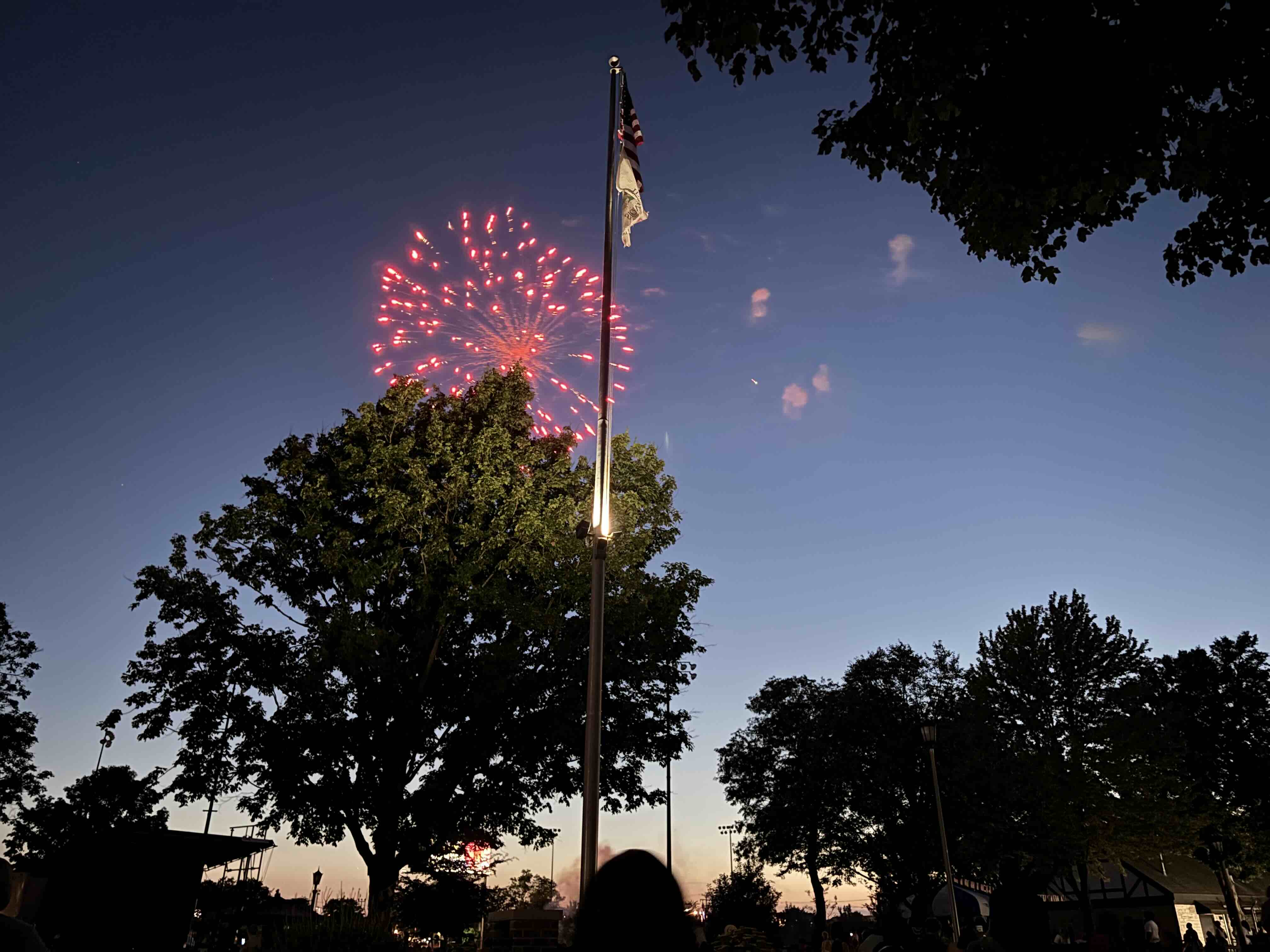
But the weather has cleared up, it's evening, and I’m sitting in the park listening to a cover band entertain the crowd until it’s dark enough for the fireworks to begin. 


I don’t think anyone’s here for the music, but live music does seem to say this is the place to be. Celebrate, come on. There are a few women standing and dancing. I’m guessing they’ve had a beverage or two. And we just heard a round of “USA, USA” yelled from the bandstand. The band leader tried but if anyone picked that up, well, I’m too far away to hear it. 


The people-watching is good. Children with parents. Parents and kids on the blanket next to me are playing a card game. Teens are casing the crowd, pairs of girls in shorts and crop tops. Who’s here, who’s new. And plenty of people like me are doing stuff on their phones. Not much conversation. The music is LOUD.


I like fireworks. I’m hoping these will brighten the end of July 4, 2025. I’ve been working on threading my loom today (and yesterday and the day before yesterday), and I’m looking forward to sitting here in the dark, hearing the whoosh after the shell is lit, that second of suspense, and then the pow! and exploding sphere of blue or red or white light. And again the suspense before the sparks fade and fall. 


Lots of kinds of people here. This is the suburb where I grew up, and it’s a more diverse place now than it was then. The kids I grew up with have mostly moved elsewhere, farther away from the city. 


It’s a hard year for celebrating the birth of the American nation, a nation founded on ideas. What can we count on as shared values when fundamental words like liberty and freedom and citizen mean different things to different people and parties? Where are we headed with the country led by a narcissistic, stupid, boastful man with an unfortunate gift for getting attention and no moral compass for how to use power? 


This too shall pass? Or will the things that are breaking stay broken for a long time? Those white men who met in Philadelphia 249 years ago and pledged each other their lives and their sacred honor — the sky just exploded! — started something we keep trying to make better. A more perfect union. A more caring and inclusive society. Lincoln's "last best hope." 


Here in the park, the fireworks kicked off with the "Star Spangled Banner" on the loudspeaker. It was followed by Bruce Springsteen and “Born in the USA.”

A protest song. Damn, it’s a patriotic night.  

Sunday, May 25, 2025

Splendor


Blog or weed? Are those verbs or nouns? 

To blog or to weed, that is the question. To sit in the sun and type, or put the gardening gloves on, kneel by the perennial bed and pull out thistles? Or maybe this is a metaphor. Are the words I'm about to type worth keeping, or will they end up in the compost pile?

It's a blessed Sunday in May when you can sit in the sun and look through the green leaves of the maples into a vividly blue sky. The house sparrows are chipping in surround-sound in all the backyards up and down the alley. A few minutes ago a dogged robin sat on the corner of the fence and sang the same five or six notes over and over again, calling, calling, with every part of its body from grey-brown tail to yellow beak. 

Let the peoples praise you, O God;
let all the peoples praise you.

We had Psalm 67 this morning.

and may all the ends of the earth stand in awe.

 Stand silently in awe. Or praise with chirps and bouncing tails. From one end of the earth to the other.

There are too many words in this world, and too many of them lately mean nothing or worse than nothing. They're weapons, or bullshit, or obfuscation, the kind that may not fool listeners but that the speaker uses to fool himself. 

"Ugh" was a significant part of my vocabulary this week, the word I yelled at the news on the car radio. "Ugh" and another word with a similar vowel. We now have a budget bill in this country that will rob the poor in order to make the rich richer while compromising our collective economic future as a nation. Because money means more to the people who have more of it? 

This morning's preaching included a lot of "I." I didn't want to look inside the preacher's soul; I didn't even want to look inside my own. I didn't come to church to be soothed. I turned to my phone and was able to provide useful affirmation to a fellow knitter on Facebook. And then I got the pencil out of my choir folder and set myself a puzzle, inspired by the entrance hymn we had sung earlier in the service: 

Immortal, invisible, God only wise,
in light inaccessible hid from our eyes.

 Its final lines:

All praise we would render, O help us to see
'tis only the splendor of light hideth thee.

Fill in the blank: 

'Tis only the splendor of _______ hideth thee.

So many things could go there. God's vision for justice, blinding unimaginable justice? God's merciful and gracious will, reaching beyond our comprehension? Or the splendor of divine love described by Jesus in the gospel for the day: 

“Those who love me will keep my word, and my Father will love them, and we will come to them and make our home with them." (John 14:23)

Surely some dazzling imperatives would come with having Jesus and his Father for housemates. Works powered by light, hope, revelation in a new kingdom, so much larger than ourselves. 


Full text of the hymn here. Psalm 67 here


Monday, March 31, 2025

The day after


Last week was "B Minor Mass" week in my world: final rehearsals for and performances of J. S. Bach's Mass in B Minor. It's a long sing (to use a technical term). A lot of singing and a lot of thinking. A lot of counterpoint. A lot of Latin. A lot. I applied a lesson learned in yoga class: smile when you do the hard stuff. And be patient with yourself.

But it's glorious music. Glorious in listening. Glorious in live performance. Glorious in hard work, and exhilarating in completion.

Bach, of course, never performed this work. (Start your background reading here.) It's not clear what his intentions were in putting this massive work together in his mid-60s, eyesight deteriorating and nearing the end of a life spent applying himself to the work of playing, teaching and composing music that he understood to be a gift of God to humanity. He chose compositions from his past work and adapted, edited, and reassembled them into the great, over-arching musical form of the mass: the Kyrie, calling on God's mercy; the Gloria of thanks and praise for salvation; a Credo, with newly-composed music for the wonder of incarnation, God becoming human like us. And a Sanctus that requires a lot of stamina to sing in 12/8 time, imitating angels floating, without effort, in the rafters of prophetic vision. 

We've been rehearsing since January, with three rehearsals in this last week before performances. I was tired all week and took naps on Saturday and Sunday afternoon, mostly because it's hard to go home and sleep after singing all this intense music in the evening. 

The concerts were a joint effort of Bach Cantata Vespers and Consonance and conducted by Grace Cantor Michael D. Costello. We sang the Mass ten years ago, so the music was not unfamiliar to me. The vocal lines are beautiful, interweaving in counterpoint that Bach took to its outer limits. Also remembered from ten years ago: the vocal panic engendered by long movements, zippy coloratura, and lots of high As for sopranos. 

But when the music is mastered, there's so much to discover as you listen while you sing. And while you sit (rest!) and listen to vocal soloists and instrumental soloists perform the movements that aren't choruses. 

So what does it all mean? Not that it has to mean anything in words, but still, what was J. S. Bach saying about God? And what is there for us, three centuries detached from the Lutheran dogma of Bach's time and place?

You can read commentary and analysis of the Mass that points to musical symbols -- the three-in-one of the Trinity, the descending notes of the incarnation, chromaticism illustrating all kinds of distressing things. I've read a number of analyses in the last few weeks and while scholars find lots to explain, I have to say that specific figures in the music rarely invoke theological concepts in my brain. I remember reading that something somewhere (in the Gloria?) showed the unity of the Son with the Father. I listened for it in various duets and solos last night, but can't honestly say it jumped out at me. 

Different century, different vocabulary. Instead I found myself thinking about all the different sounds and colors in the movements of the Mass. Flutes here, oboes there, violins high and low, plaintive, busy, and celebratory. A movement for the bass soloist accompanied by horn and two bassoons--who does that? And can keep it going that long? And all the different sounds in the chorus -- suspensions and resolutions, fugal entrances crescendoing one on top of another, step-by-step through a harmonic progression, or up the scale. Sudden unisons. Hushed resolutions. Explosive consonants. Loud cadences, quiet ones. Old-school counterpoint, baroque elaboration.

Yesterday as I listened I thought about Bach trying to show us something of what God sounds like, reaching for perfection beyond words, beyond literal, word-dependent theology. I thought about what it means to be a creator, a part of God's ongoing creation -- or, if you will, a creative person in an ever-demanding world of wonder, glory and terror. 

In that world, the world of Monday-morning headlines, we remain creatures dependent on mercy, received and shared, clashing and resolving. And in our finer moments, our God-honoring, creation-honoring moments we shared in the music of big, big choruses of gratitude (Gratias agimus tibi) and in the same music notes used in hopeful prayers for peace (Dona nobis pacem).

Transcendence. 


Friday, February 28, 2025

Anniversary blog 2025

Sunny dishtowels on the loom
Dishtowels on the loom. 

I went to my regular Friday morning yoga class today. It's "Hatha Yoga for the Core" which means there will be crunches or boat poses and a period of harder work and held poses in between the careful breathing and stretches and final rest pose. I like the instructor of this class because she finds a nice balance between predictable routine and bringing in new movement or new ideas. 

New to me today was a technique for shutting down the senses and moving into meditation that recalled the three monkeys who "see no evil, hear no evil, speak no evil." We shut our eyes and placed our index and middle fingers softly over our eyelids, ring fingers on the nose, and pinkies on the lips. Our thumbs gently pressed our ears closed and we sat for a minute. Resting. 

I struggle these days to put my phone down or step away from the computer screen and take a break from the awful stuff that continues to rain down from the current presidential administration in Washington DC. So much evil to see! So much to object to! I'm emailing my representatives in Congress regularly, and also sending messages of support to Illinois's governor and attorney general in Springfield. I write mostly about Medicaid, but so many other issues leave me feeling disturbed and depressed: USAID funding, civil servants losing jobs willy-nilly, the betrayal of Ukraine, petty reprisals against political opponents. 

Closing your eyes to it all -- is that a better alternative? Is it even possible? I know people who don't pay much attention to politics, and others who think that the federal government needs a good goosing and choose to ignore the details and possible repercussions of all the upset. 

I can't ignore the issues and actions that I'm upset about. Maybe that's the way I'm wired -- to complain and object and protest. To want things set right. Or maybe it's the type of Christianity I grew up with, the intense discussions we engaged in about race and poverty when I was in eighth grade in a Lutheran school in the spring of 1968. Maybe it's my demographic: college-educated, urban-suburban white woman, voting Democratic most of my life. 

Whatever. 

I do know that I need a rest. It may be time to take up meditation—again. To sit for hours at the loom and listen to a good story instead of political podcasts. To clean closets or choose new colors for the pillows on the couch. To contemplate the smeary blue of today's late-winter sky and start to watch for snowdrops and crocuses. To smile and laugh as the fifth and sixth-graders I'm working with discover the human fun and foibles in their characters in "A Midsummer Night's Dream." 

Sunday is Transfiguration, the last Sunday before Lent, which is when I mark this blog's anniversary. I have been posting for 19 years here at The Perverse Lutheran, through all kinds of times. I just now took a look back and saw posts I remember and posts I don't. Posts that remind me to look for God's grace, to look for the light, and to remember that hope does not disappoint us.


Here's a previous Transfiguration anniversary post. And the Ash Wednesday 2015 post from a few days later has some fun moments. Reminds me why I'm retired.

Monday, February 17, 2025

Sad

Gwen, Linda, and Karen, June 1961

Presidents Day 2025

I took a walk this afternoon while my daughter was working out with her trainer. It was cold as I walked east on Madison Street, and even colder when I turned back and faced west. But I was dressed for the weather — warm coat, new insulated gloves, wool hat and flannel-lined jeans — and both my mood and my body needed the brisk walk, the cold air on my cheeks, in my nose and my lungs. 

Madison Street in Forest Park and the cross streets to the south are my old neighborhood, where I rode my bike and walked to school. As I headed down Beloit, towards my mom's old house, I thought about being sent to school in this kind of weather, walking four or five blocks with a scarf wrapped over my face and pants on under my skirt. Off we went on cold winter days, and nobody thought much of it. School did get cancelled when the temperatures were consistently below zeros, and we had several days off during the Big Snow of 1967

Today my walk took me past the old savings and loan building at Madison and Desplaines. It's empty now and it's for sale. I looked through the front window and down the spiral staircase that led to a community room in the basement. I remembered going there on a Saturday afternoon with my dad and my sisters to get the polio vaccine, probably in 1961 when the oral vaccine became commercially available. It was a community event. We had probably brought a note home from school from the public health department sponsoring the event. We waited our turn and eyed the sugar cubes holding the vaccine  lined up on the table. We picked one, popped it in our mouths and crunched it and came back a few weeks later for a second dose. 

Going to First Savings, the first bank to occupy this building, was not a novelty. We went there happily on Saturdays with my dad when he did his (in-person!) banking. Most days we left with small rolls of LifeSavers, offered to us by the guard or the receptionist. More sugar. 

I imagine this easy-peasy polio protection meant a lot to parents. Of course they took advantage of it! Thinking back, I realize that I knew some children who'd had polio, who walked with a limp, whose parents had probably been very scared when they were sick. It was not something I had to worry about with my kids. 

As I was waking up this morning, head still buried in the pillow, trying to zero in on what day of the week it was, the first full sentence that came to my mind was, "I am sad for my country." This is what comes of doom-scrolling before bed. The ironies inherent in a 2025 celebration of U. S. presidents (I'm looking at you, Abe Lincoln and General Washington) didn't dawn on me until later. 

In my lifetime I have seen these United States become a more inclusive place, that arc of the universe bending towards justice. I don't know that I remember the passage of the Civil Rights Act, but I do remember Everett Dirksen, the Republican senator from Illinois who rounded up votes to make it possible. I remember the civil rights struggles, the voting rights act, the gradual changes in the acceptance of the LGBTQ community during my college and graduate school years, and the IDEA (Individuals with Disabilities Education Act). 

When I was a child, my aunt taught a Sunday School class for what we then called "mentally retarded" children and adults. I learned from listening to adult conversations that many of these individuals, who lived with their parents, didn't go to school. Schools for them were far away, or expensive, or unable to take any more students. Decades later, thanks to the IDEA and federal funding for special education, my daughter who has Down syndrome was picked up by a school bus and educated in our local public schools. 

With Medicare, Medicaid, WIC, and SNAP, we've also become a nation that cares for the sick and feeds women, children and families who simply need to eat.

The wrecking ball of the Trump presidency and Elon Musk's DOGE empire are threatening and destroying one thing after another, things government does for the good of all. American media has too many pundits already; I don't need to my bit about rich, narcissistic, foolish white men, their delusions and their resentments. 

But how did we get here? Many Americans go into the voting booth every four years with "throw the bums out" as their decision point. Incumbents lose when people are unhappy about the economy. It's not necessarily a formula for rational governance, although it seems to work well in politics. 

But what's happening in the U. S. right now, what's making me so sad, is the shift in values in our leaders. They don't care, they don't take care, they're not even hypocritical about saying they care. They certainly don't subscribe to the words of Martin Luther King Jr., who wrote that "unless all are free, no one is free." Ever-expanding freedom means freedom from want and fear, along with the freedoms enumerated in the Bill of Rights.

The world keeps changing. Social media, social isolation, polarization, globalization, changes in how the economy works and who it works for — it's a lot. Our brains were designed for making our own little gardens grow. The show of power, the slashing and burning, are reassuring for some, sticking it to people who might take what they already have, or wish they had. But it makes the world less good for everybody.

It makes me sad.


Sunday, January 26, 2025

A Cantata Sunday, late January 2025


Cantata Sunday (kənˈtädə sənˌdā). A Sunday on which a Bach cantata is performed as part of Bach Cantata Vespers. Also known as A Long Day at Church. Often thoughtful, sometimes tearful. 

One of the petitions in the Litany we use in the vespers liturgy is a list of people in need, culminating in "and all who await from the Lord great and abundant mercy." Once upon a time, when I was younger and self-involved (more self-involved than I am now),  I thought this was group of people awaiting mercy was a subgroup of humanity, people with particular, urgent problems who needed God to solve them now. Why did I think this? Because I included myself in that group and could not think much beyond myself. 

Foolish youngster! Who among us, from day-old newborn to gray-haired elder, does not need God's great and abundant mercy? I have long since yielded up my miserable hubris. Other people feel scared and vulnerable, too, and have intractable problems, unsolvable dilemmas. Knowing this makes life easier. I'm not alone. 

And we need God's mercy more than ever now, after a transition in government here in the U. S. You don't need a recap here from me. There's plenty to read everywhere you look. A lot to take in and a lot for the people of God to respond to, a flood of willfulness meant to clog our discernment and slow our response. 

Today at church I heard some particular groups of people named who are feeling dismissed and frightened. They are part of "all who await, etc." In naming some, we should not forget others lest we allow our self-protecting, self-justifying brains to divide the world into People Like Me and People Not So Much Like Me. 

I once thought I was special when we came to that petition in Evening Prayer — I had something I very much wanted a merciful God to grant me. But I was not alone, or part of a select group. All, all await God's mercy. Migrants, yes, the LGBTQ community. But also people who are disabled, people who need Medicaid to provide health care, civil servants, military leaders, lawyers and judges, refugees, and more. Fortunately God's mercy is great and abundant.

What disturbs me more than any single Executive Order of last week is the way our nation's stated values have shifted. "For all" has become "for certain ones," or only for "real Americans." I guess, on a civic level, one could discuss this, even justify the ins and outs, who's alike, who's different.  Earthly kingdoms are not God's kingdom. But we who, trusting in God's mercy, prayed and sang BWV 111 together today, saying "God's will is best" -- it's up to us to be part of the mission of bringing God's good and merciful will to the world. 

Pick your issue. What are you concerned about? Who can you speak for? Where can you do the most good? And join the ensemble. Many members, one body. 

Seems almost heretical to add this after Bach -- but I keep hearing that "High School Musical" refrain in my head. "We're all in this together."