Sunday, November 07, 2021

All Saints Sunday 2021

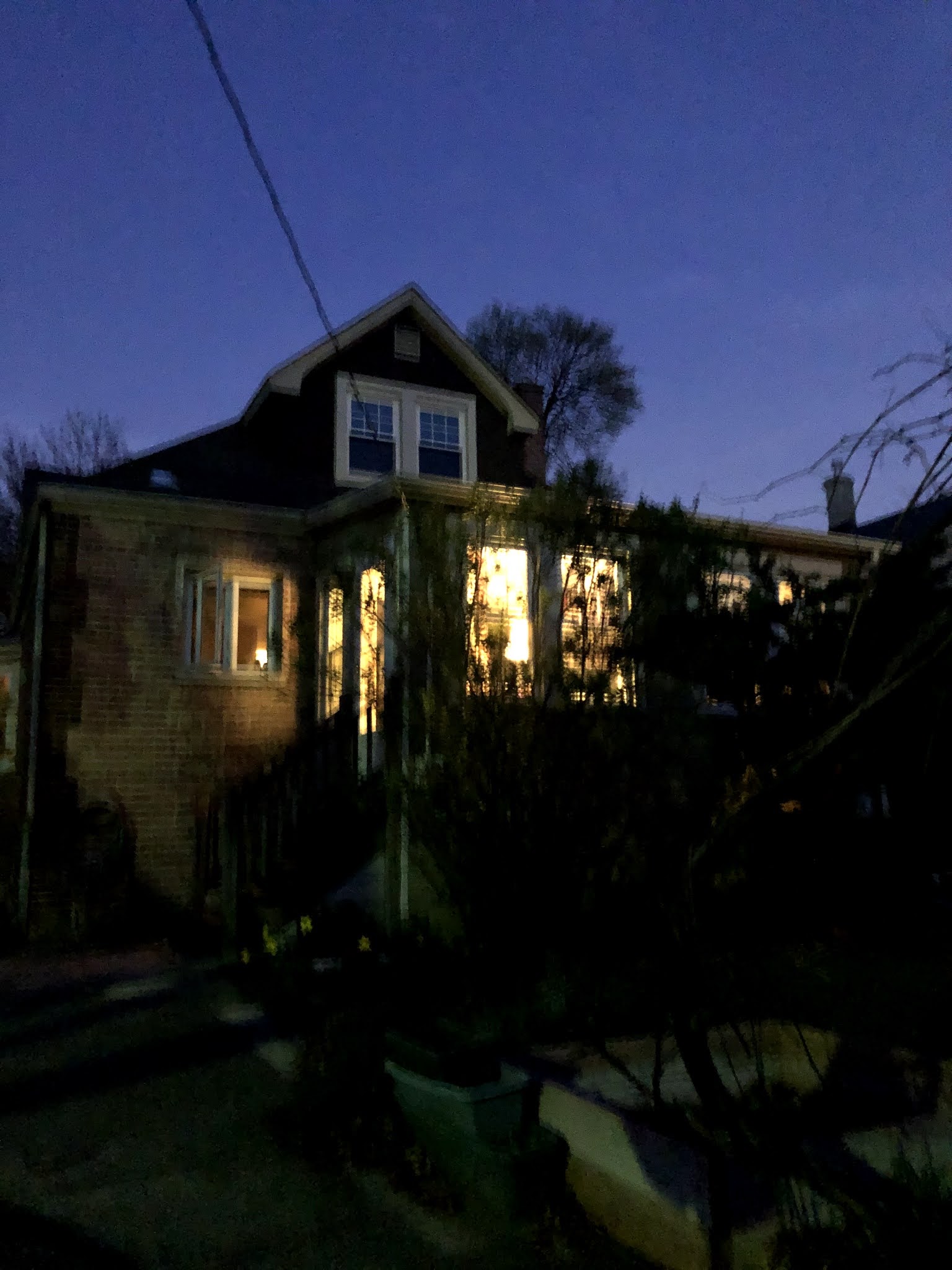
The first, far-too-early sunset of Central Standard Time has cast blurs of pink and purple all the way across the sky. I saw them even from the east-facing windows of my living room. Not quite 5 p.m. and trees, evergreens, everything close to the earth was in shadow. If I had a fireplace I'd be thinking about building a fire, more for the light than the heat.

Metaphors were everywhere this morning in church on All Saints Sunday, from the pilgrim throng to the throne of God and the saints singing in glory. And the golden evening brightening in the west in the hymn "For All the Saints," just like the real one here in the Chicago suburbs a little while ago. 

I am steeped in all these images from a lifetime of All Saints celebrations, funerals, Easter services and prayers for the dying. On some days, in some circumstances, they open up the heavens for me, or lift the veil or something else -- alas, something metaphorical -- between life and death, between what can be known and what can't. On other days -- well, I can only marvel at the human poetic imagination.

Poesis, philosophically, is making something -- making something that did not exist before, such as a poem, a play, or a musical composition. You make it by speaking or putting words on paper, by singing or recording notes on a staff. Not as impressive as God speaking light and darkness, dry land and living creatures into existence in Genesis, but still, the making of a poem (or a blog post) is a creative act. There's no more blank page, there's something there. 

So it follows that other somethings must have been brought into being by other creators. And are those things brought into being real things, or just images of some greater and more perfect reality? I'm in far deeper than I set out to be. The little I know about Platonic ideals is nipping at my frontal cortex, and since what I know is indeed very little and I am not a methodical thinker, it seems best to back out of this mess. 

And return to pondering those metaphors which seem entirely other-world to me lately. Not as in heavenly, but as belonging to a very specific world or tradition within the church and western literature and liturgy, which may be slipping away. Do they still have any meaning for us today? Would they have any meaning at all outside the church, away from being among those who attend worship services or read Christian devotionals? 

There is, of course, the music associated with these texts, music brought to the texts to bring them more emotion, more dimension. You don't have to know the Bible to grasp the Brahms Requiem or the Verdi.

For me today, the best text from this morning was this one* which is very direct:

All of us go down to the dust, 
but even at the grave we make our song: Alleluia. 

We've all seen decay, we've seen the ashes. We've stood at the graveside. We all die, yet we rejoice in the beauty and mystery that is life on earth. Our brains can grasp -- or perhaps create -- that transcendence. 

Thanks be to -- God?


Washington Island sunset 

*Evangelical Lutheran Worship #223, setting by Matthew Mummert

Thursday, July 29, 2021

A future with hope

For surely I know the plans I have for you, says the Lord, plans for your welfare and not for harm, to give you a future with hope. Jeremiah 29:11.

I copied this Bible verse into a draft post weeks ago, wondering -- not if it were true, but in what ways it could be true. Surely not as a blithe promise of prosperity or happy endings. I'm not averse to them. I've spent a lot of time thinking surely one was out there somewhere. But even a happy ending never exactly ties up all the loose ends. And a future with hope is not a destination, it's a moving target.


I've just celebrated my birthday. That and other things have sent me looking back through the eras of my life. 


A friend recently sent me photos of the church my father served as teacher and organist from 1955 to 1958, when I was a very small child. In the years after we left, in a time of growth, the congregation built a new school and then a new church a few blocks away from these aging buildings. 


What happens to the old churches when congregations move on? Sometimes the buildings are sold to new congregations. In gentrifying neighborhoods, perhaps, they're turned into restaurants or libraries or other public spaces. Lutheran elementary schools become preschools or after-school centers. Or, with no plans or resources for future use, buildings stand empty and decay. 


My only real memory of that old church is of a Christmas service. It must have been the school children's Christmas Eve service, because I remember straining to see the pageant up in the chancel, to see Mary in her beautiful blue robe. I was only three and a half years old and my mother, my two younger sisters and I were sitting far back in church.  A kind gentleman (as my mother would say) sitting near us allowed my sister Linda to stand on his lap so she could see better. (I think this is true.) But I had to stretch my head and shoulders high to see between all the heads in front of me, and I was disappointed. 


At home, a two-story white house down the street and around the corner from church, I'm sure we'd been getting ready for Christmas. That would have been the year that Linda stepped on Baby Jesus and crushed him. We cried—but that's another story. On Christmas Eve we came back home from church and discovered that Santa had come to our house while we were gone. Daddy must have slid off the organ bench quickly after the final hymn and hurried home to get the presents out of their hiding places.


I picture all of this now as if it's a movie set in the 1950s -- the church-going version of "A Christmas Story," with little girls in Christmas dresses, church shoes and wool coats. The photo of that old church in Saginaw fits right into the production design.


But what of it? What now? What plans does the Lord have in store for this church, for Christ's church?


Eighteen months of pandemic have changed the pace of change everywhere. Children's progress in math and reading has slowed down, as measured on standardized tests. Other kinds of changes have accelerated, especially our society-wide awareness of disparities between rich and poor, white and black and brown. Church attendance, church affiliation -- these measures of religious behavior have been declining for years in many denominations. 


And then there's the whole planet in the grip of climate change. heat waves, flooding and wild fires.


Hope is a moving target. God lives in the future. 


Thank you to Jim Gladstone for the photos.

Monday, May 24, 2021

Attachments

Sage in the foreground, chives in flower at left. 


"I respect you," I said to the armload of thyme plant as I lifted it away from the ground. 

"Thanks for taking one for the team."

I dropped it into its new hole in the garden, at the base of the grape vine, three feet closer to the garage. Moving it was like picking up a pile of books and papers just as it lies on the table or couch and lifting it, unsorted, over to the desk—though the thyme holds together more stubborly. It's a felted mass of tangled stems, tiny leaves and, in late May, even tinier purple flowers, that has been rounding its way out onto the patio and any other empty space it finds. It smells like cooking—the seasoning for roast chicken or turkey or Thanksgiving dressing. In its new home, it needs patting down or maybe a comb-through to pull out the dead leaves from last. It will settle into in its new space soon. I'm pretty sure this mighty plant is indestructible. 

And yeah, I'm talking out loud to an herb, ascribing a personality to it and apologizing for bumping it out of its bossman place. I have attachments to this little patch of dirt.

Moving the thyme made room for last-year's lavender to grow, and for a second lavender plant and a marjoram and the dill that was already half-dead in the pot and might not come back. I'll have to trim the sage back just to be fair but not right now. It's got tall spiky purple flowers, where a few minutes ago I saw a hummingbird. 

I would not want you to think I'm a gardener. On a lot bigger than most of my neighbors' I have less than 40 square feet under control. My lawn is made of dandelion stems, waiting only for a strong wind to seed the neighbors yards. Last week I bought some new hostas for a shady spot next to the house, but there's a significant aching-back worth of weeds to pull out there before I can plant them.

Lots of birdsong in the backyard this morning. I'm just happy to be here with my herbal friends. 


Tuesday, April 13, 2021

The server is down -- until tomorrow

"dentist chair" by Nursing Schools Near Me is licensed under CC BY 2.0

I arrived at the oral surgery office today, three minutes late for my appointment. When I went to check in at the desk I was told, "The server is down," and then asked, "Have you been here before?" A few minutes later I was told they would have to reschedule my appointment, which, of course, they could not do right then, but only when the server comes back up. 

I wondered what message the office person, in her colorful scrubs, with her pink clipboard and heavily (but beautifully) mascara'd eyes, was getting from the half of my face above the face mask. I'm pretty sure my eyes and forehead conveyed a full measure of irritation and unhappiness. It's not like they were telling me, good news, I wouldn't have to get this tooth pulled after all!  

(If you're asking why computers going down means you can't pull a tooth -- I dunno -- probably something about images stored on the server from an earlier visit to a different office of the same practice.)

By 2:30 this afternoon, the appointment time, I had invested approximately 20 hours of dread in this trip to the oral surgeon. And yes, I am counting hours spent dreading the appointment while sleeping and not sleeping, as well as the usual waking hours. There are many layers to this. I am not new to having teeth pulled (nor to root canals). Dragging myself through this includes the yuck of standing in line at the pharmacy to pick up after-appointment prescriptions with my mouth still stuffed full of cotton. Also, tooth decay and gum disease are reminders of mortality to me. My mouth is dying faster than other parts of me. (Read more: "Dust to dust" from Ash Wednesday 2006.)

It was a beautiful April afternoon -- delicate green leaves just emerging in the trees overhead against a soft blue sky. I am not without blessings, including friends who listened to my griping and returned more sympathy than I deserve. Instead of the milk shake I was planning to have for diner, I've enjoyed a chopped salad, a chocolate chip cookie, and an Edmund Fitzgerald Porter. 

It's been a long year of COVID worry, isolation, and inaction. Just like the seven-year-old version of me, I'm looking for a good ending to this story.  But it's in process; we're barely able to draft the story of how we come out of this, while trying to figure out how we join up that story with the one we were telling back at the beginning of 2020. 

Roadblocks appear -- today, for me, a cancelled dentist appointment, and yeah, much bigger problems in the big world in which I play only a bit part. I guess we wait until morning, when we're back online again, and get back at it. 


Tuesday, April 06, 2021

Quietness of evening


I sat outside for a while after the sun set tonight, through twilight and into darkness. 

At first I was listening. There was lots of birdsong while there was still a bit of light and a blue sky. Not just insistent cardinals, but lots of different sound.

All day the sound of nail guns echoed through the neighborhood, as roofers replaced a roof across the street. They worked until it was dark and finished the job. The pounding faded to the sound of engines idling as they loaded their tools and ladders into a pickup and a van. One drove off, and a few minutes later, the other. I hope they went home to good suppers and people glad to see them.

The birds stopped. Silent dog walkers passed, bicyclists with their headlights glided down the middle of the street, passing an 8pm jogger. I listened to silence all around me and sounds of traffic in the distance. I breathed carefully as I tried to quiet my mind. 

News websites everywhere are full of stories about coming out of the pandemic. Personal growth stuff like how to hang onto the good habits that helped you hang on through the last year. Big picture stuff like has the nature of work changed for good? And much more, as they feed on each other. I click on headlines but seldom read to the end. 

I did follow one thing today all the way through, and I think it's what inspired my evening efforts at quiet: Who We Are Now, in the New York Times, with comments from readers about how they've been changed by the pandemic. Pretty photos float down the page with short quotes and a few longer stories from people who faced fears and worse and who seem to be deciding as they described their lives, to be okay. 

It's takes some work to be quiet, to listen and be still as the darkness falls. More than once I had to turn my phone off and over after restlessly clicking it on and looking for something to get the hit of dopamine. Thought for a minute about getting a bowl of cornflakes to help quiet my mind. (Helpful, I find, when awake at 3am.) I called my monkey mind back more than once to enjoy some peace and positivity before it wandered off again. And of course now, writing, I'm trying to experience that quiet again from my living room chair, wondering who I am now. 

Saturday, April 03, 2021

Controlled burn


Good Friday, while on a walk at the Morton Arboretum in Lisle, I watched a controlled burn -- fire deliberately set around Meadow Lake, burning away last fall's dried grass and weeds, turning the earth black and covering it with ash. 

The burn -- the bright blue sky, the orange flames, the brown smoke and then the white -- seemed sacred. 

Perhaps it's because everything seems sacred on that holy day -- so dark as we tick off the slow suffering hours Jesus was on the cross, yet so lit with that word of theological judgment: Good.

Watching at a distance, we could see the progress of the burn around the pond. At our feet there was blackened soil -- yesterday's burning, or perhaps last week's? -- dark crowns of plants and bits and slivers of new, faint green shoots. In the distance a trail of workers in their yellow fireproof suits curved around the lake, setting the fire and controlling it as it burned out. A small truck with a tank followed slowly, just in case. We watched as a tall stand of grass flared up suddenly sending bright orange flames ten or twelve feet into the sky. Very exciting, especially for the two small boys standing in front of us with their mother.

We burn away the brush, the waste, the invasive stuff to give the new shoots a chance to thrive. And yet those new shoots come from old roots. In our lives it's seldom a controlled process. But on this Easter Day, we pray that it turns out to be a good one. 

(More about controlled burns in wetlands.) 

(Thank you to Lisa for the photo.)

Saturday, March 13, 2021

Day 366

Four sweaters, five shawls, thirteen or fourteen Fair Isle hats, plus two pairs of socks. Those are the knitting projects I’ve completed in year one of the COVID-19 pandemic. Some were knit from stash, meaning yarn bought years ago, on sale, on impulse, on vacation: merino and alpaca in a heathery purple, deep green laceweight Malabrigo, a gray to deep fuchsia gradation. Sweater yarn came in the mail, purchased online at yarn.com. Fair isle hats came in kits from Sievers on Washington Island, to go with the Katie's Kep pattern from the Shetland Islands in Scotland. 

There’s a surprising harmony to the colors when I pile everything together in the sunlight in the living room chair,  brighter and warmer than I remember -- or is that just today's late-winter sunshine? 

Day 366. Your mileage may vary on the number, depending on what day last March you count from. For me it's Friday, March 13, when I wrapped up my office computer in my fleece jacket and carried it to the car. The night before I'd had dinner with my daughter, my son and his friend -- my last meal in a (nearly empty) restaurant. 

Life wound down, flattened down. 

That covid curve we flattened last spring, peaked again and again, while day-to-day life seemed flat and colorless. Flat as a computer screen, dull as dinners of the same four or five home-cooked menus made week after week. (I live with a very picky eater.) 

Flat also because of not wanting to cry. Or not believing in joy. Just trying to get through until dinnertime, bedtime, morning. 

Day 366, ten days past my second shot. I went out to do some Saturday errands this morning -- the hold shelf at the library, the drive-up window at the bank, curbside pick-up for food. It's a beautiful day, the kind of Saturday that a year ago would have found me poking through thrift stores or buying stuff I had no idea I even needed at Marshall's or Home Goods. The past year has taken the edge off shopping. A year of looking at all the stuff already in my house has left me pretty sure I don't need more. I drove on home.

And then my daughter and I went out for a bike ride this afternoon, which means she rides her adult trike, "the best birthday present ever" from last December, while I walk in front, in back, or alongside on the grass. We were headed north down one of the streets in our neighborhood when we heard and then saw the Fitzgerald's Community Truck Concert stopped on the other side of the street a few houses in front of us. We listened to "Wild Mountain Thyme" and two more songs, with a live singer and guitar. Neighbors gathered, bike-riders got off their bikes and sat on the curb, people came out of their houses. Grown-ups, children, listening, grateful, socially distanced. 

A live landscape that was not flat at all.