Saturday, June 24, 2023

Sunrise

Petunia (Petunia ×atkinsiana) Dandy1022, CC BY-SA 4.0, via Wikimedia Commons


The sun just rose over the roof of the house across the street. It hit me in the face, and I smiled back. It shines on the front side of all the things between us two -- the striped hostas at the base of the fence, the floating leaves of the grapevine, the tree trunks, the potted petunias. 

Later today it will be hot and noisy. There'll be bees in the garden and cars in the street, things to take care of, decide, do. Now, it's bird conversations, cool air, tall, silent trees. 

I woke up at 5 this morning. Keeping my mind clear enough to go back to sleep seemed futile. My phone said it was still a few minutes before sunrise. Opportunity! What does sunrise look like on a day so close to the summer solstice? I sometimes see the sun rise in December. But what about now, today?

What to do with the bonus time in the morning? Finish the novel I've been reading — "Drive Your Plow Over the Bones of the Dead," by Olga Tokarczuk, a Polish writer and Nobel Prize winner — and then shake off its world in the light of day. The book is a murder mystery of sorts, set in Poland on a plateau near the border with the Czech Republic, far from Illinois -- seven hours ahead. The sun there is already at the top of the sky and soon heading back down. 

Light shining recalls last week at my church -- five mornings of Vacation Bible School for children from preschool through age 10. I was not a volunteer at the crafts or snacks or Bible story station. I was there for just the first 15 minutes each day, playing an astronaut (improbably, against type) in the opening skit. This is where friendship with the Children's Ministry Coordinator will take you. My character Mickey Wey had some issues throughout the week. And the solutions, Monday through Friday, were always a variation on "shine Jesus' light" into good news or bad. 

Our relationship with the sun's light is so elemental. Smack, it hit me in the face this morning. (I've heard it rises like that every morning.) It's the same sun that ruled over my childhood summers. Of course it figures into our efforts to grasp and understand reality beyond ourselves, along with the basic rhythms of life. Stones, sundials, carvings from ancient civilizations show the sacred power of the sun and its light. "Shine Jesus' light" is a good metaphor. It works, no matter how old you are. It tells you a lot about how to live as a follower of Jesus.

It's almost 7. My wake-up alarm will go off any minute now. The sun's been up for almost two hours. It's still shining at me through the maple tree on the corner, but the early morning magic has faded. In a half hour or so it will be above the trees and I'll need to tilt the patio umbrella to shield my eyes and my computer screen from the glare. It won't be shining golden light into the nooks and crannies of plants my world view, but it will shine down on a busy Saturday's chores, shopping, recreation. 

The narrator — the unreliable narrator — of "Drive Your Plow, etc." is an astrologer. She looks to the angles and motion of planets crossing one another's influence to find truth and direction about human fate, as well as to discover the date of her own death. Astrology, the casting of horoscopes, has elaborate rules. They're stated with authority in the novel, but the mind glazes over these as you read them -- at least mine did, with no grounding in the subject. The stories created from the rules, however -- well, they are the story, sometimes truthful, sometimes not. 

Much of the novel takes place at night. There are warm, loving human encounters and dark, drunken violent ones. That's part of what drove me out of bed this morning -- I wanted to read the resolution to that unreliable story-telling not while drifting off to sleep, but in the morning light, . 

Shine the light.

Sunday, May 28, 2023

Pentecost 2023


"Birdsong. Inspirited."

I wrote this on a page in my notebook this morning, as I drank my coffee outside at the patio table.

Today was another perfect May day--clear skies, warm but not hot. And oh, so quiet at 8am. Yet in the silence, birds, one chip-chip-chipping from the tree near my chair, others whistling more melodic tunes down the block. Like a fourth dimension of being. The sun was still low in the sky, lighting up the undersides of leaves and branches and shining warmly into my face. 

"Inspirited," I wrote on the page, and then, not sure if this was really a word, I looked it up in the dictionary app on my phone. 

        Inspirit: to infuse with spirit. Syn. spirit up.

Spirit up. It's the day for it--Pentecost. Or should that be Spirit down? As in descending onto the disciples' heads in tongues of fire?

I went to church, sang the hymns -- including two big 16th-century Lutheran chorales, "Creator Spirit, Heavenly Dove" and "Come, Holy Ghost, God and Lord" that I'm always surprised to discover are two different hymns. Perhaps we should just sing the ancient "Veni, Creator Spiritus" and be done with it. 

Honestly, I didn't need tongues of fire, the rushing wind, Peter's sermon from Acts, or even Jesus in the upper room. But the great blue heron I saw fly overhead while stopped at a stoplight as I drove to church?

Spirit up!

Tuesday, May 23, 2023

"I always think ... "

It's been two months since I've published a post here at the Perverse Lutheran. A long time. I've had thoughts and ideas, but they've evaporated quickly, helped along by the glare of self-criticism. 

So I'm trying "Random on a Tuesday" this morning and making a commitment (well, about 85 percent) to hitting publish, no matter what. (Please, dear reader, accept my apologies.)

1. It's almost 10 a.m. I've been awake since 6. I had my morning coffee but it did not prevent me from dozing off while reading, around 8:30 a.m. Such a pleasant feeling, floating from sleep to wakeful and back again, on a morning in May, in a patio chair under a hazy blue sky, birds chipping and chirping in the bushes, cradled by green, lilac-y fragrance.

2. This is the problem with blogging lately. Item #1 was the one single thought I had as I started this post, and it was worth only two sentences. 

3. I've been very busy directing a junior high musical production of "The Music Man Jr." It's my third time directing this in one version or another. One of my favorite moments comes near the end of the show, when Harold Hill, confronted by a boy who needed to believe in him, must tell the truth and confess to being a liar and a crook. But he tells the kid he's a great kid and that's why he wanted him in the band. 

"What band?" says Winthrop. 

Liar? Crook? Hill reveals something more about himself: "I always think there's a band, kid." 

He can't quite make it come to pass, but still he has a dream. Every time, he believes. 

4. "I always think there's a play, kid." That's where I find myself. Conjuring kids' school plays into existence, I feel seven years old again, or ten, with a grand vision of something I'm trying to turn into reality, usually against all practicality. A child’s dream. Will they believe with me? Rehearsals look like I'm in command. I'm organized. I plan. I have a spreadsheet. I tell my cast to count off by seven and move them around in groups following the circles and arrows in my notes. And I wonder if anyone can see what I see. And why would they?  

5. In plays we play together. We agree to do this and we hope to bring the audience along. Read a novel and you enter a world constructed in one author's head, its own reality. I just finished reading a novel called "Users" whose main character is a designer of virtual reality experiences that evolve and call on users to contribute content which is then shared in other users' experiences. (Think Twitter or Facebook as VR.) The protagonist is selfish. He doesn't just interact with people. He plans how to get what he needs from his wife and daughters and co-worker. His relationships are superficial and a mess. Near the end comes a reminder that we can't ever really know what it's like to be someone else. His teenage daughter's reaction: well, duh. 

6. But I’m always interested in what it’s like to be someone else, or to be inside their experience. Or interested in what they say about it. If I breathe just the right way, can I duplicate their experience in my body and brain?

7. Which reminds me to write something more about being present on this fine May day. Morning has turned to early afternoon and now to late afternoon. There's an electrician running a grounding line in the basement for the solar panels on the roof. Electricity went out in the bathroom for a while. And I just picked up three more novels from the library. 

8. What I was reading when I dozed off earlier this morning was a new translation of the writings of Julian of Norwich. Time to pick it up again. 

Friday, March 24, 2023

It's a lament

Klagen. It's a German word, pronounced with an "ah" vowel. At the beginning the back of the tongue is up against the soft palate; you push air past it to release the k sound. The l is formed as the tip of the tongue touches the alveolar ridge behind the front teeth and then lowers; there's a little more pressure involved in German than in English. You need a big open space for the ah, especially if you're singing, with the tongue dropping to the bottom of the mouth. The g at the beginning of the second syllable is made like the k, except it's voiced, which means the vocal chords tense and vibrate as the air is released; put your fingers gently on your throat and you can feel the vibration. The e is a schwa sound, open, neutral, represented in the phonetic alphabet by an upside down lowercase e. Close off the sound with a final n, short but pitched if you're singing.


Klagen is the word for lament that lofts through the opening chorus of Bach's St. Matthew Passion: "Kommt, ihr Töchter, helft mir klagen" -- Come, you daughters, help me to lament. The ah sound makes room for the music, but the k in kommt and again in klagen brings the intensity. Choral directors want the vowel sound on the beat and the k in front of it, sent out into the room with emphasis and clarity. There is no soft edge on this grief, no sliding gently into it. It insists and is then sustained, on a long line of pulsing sorrow. 


The music goes on to call for witnesses: Sehet! See! See what? See the Lamb of God, suffering, slaughtered, patient, bearing the pain of the cross out of love and grace. A call for lament. A majestic piece of music, complex, graceful, intense, emotional.
Up until a few days ago, I was still lost in the details of this chorus as part of the choir preparing to sing the St. Matthew Passion this weekend. I'm in Choir 2, voices that interject questions—where, who, what—when called on by Choir 1 to join the lament. I don't want to screw up and sing those interjections on the wrong pitch, or worse, the wrong beat, so I focus on singing the notes spot on. Let the meaning of the words take shape in the ears of the audience. 


But last weekend I attended a memorial service online which began with Silence and Lament. Verses from the Psalms expressed sorrow and desolation. We read a Litany of Lament in which the congregation's response was "Living God, be with us in our pain." 


Not "Living God, take away our pain." 


No, we're came together to talk about grief and sorrow. The homily spoke of pain and protest. Mourners named what was lost and shared their deep grief. At the end, there was a prayer for consolation, and the life that was lost was commended to God's care. But there was so turning away from lament. I began to think of things in my own life that were, perhaps, insufficiently lamented.


The experience changed how I'm thinking about the St. Matthew Passion, about the word klagen and this chorus that invites listeners into the contemplation of Christ's death on Good Friday. Many, many words have been written to describe, analyze and explain this monument of western choral music and theology, a great work by a great composer. In the past weeks I've searched for a few choice words to describe it in publicity materials. Lament has not been one of the words that I've used. But now it's everywhere.


Somehow I missed this earlier. And it's not because of the challenges of singing in the chorus, of being ready to spit out fast-moving German texts at the drop of a downbeat. It may have something to do with the solo arias that express lament being long. They're gorgeous, each one unique and complex, with highly emotional, personal texts. But they're a lot to sit through under bright lights and the imperatives of looking interested and staying alert for what's next. 


There's a bigger reason why I haven't responded to the heavy call of lament before in this work. Ironically (perversely) it's bound up in being raised Lutheran on a steady diet of -- yes, I'll say it -- penal substitutionary atonement theology. I don't much care about the systematic theology behind it, or even how you get around it. But I will confess that it's left a grim residue in my celebration of Lent and Holy Week. "I crucified thee," we sing in a Good Friday hymn. There's heavy guilt there, self-accusation and deep feelings of unworthiness. As a child I took this way too much to heart. Decades later I squirm and resist, rather than wallow in shame. 


When I joined the lament in the memorial service last weekend, I felt my own grief and loss rise from heart to throat, remembering. At the next day's Passion rehearsal I felt the lament rise there as well—kommt, klagen. It's a lament for Jesus, yes. But as we feel things with one another, it becomes a lament for everything—so much grief, so many losses, the sorrow of the world. The sorrow of parents who've lost a child, of people who've lost a life partner. The sorrow of earthquake survivors in Turkey, of civilian victims of the war in Ukraine, of men of color suffering under police beatings in America. 


There is much to lament -- the world should not be this way. But Jesus in his Passion carries our sorrow, is with us. Laments with us. It doesn't take away our pain, but Bach's music reminds us that love -- love from God -- transforms it.

Tuesday, February 07, 2023

My blue car

"I love you, blue car." 

I said those words spontaneously yesterday and again today. They came out of my mouth with no thought at all as I cleaned out my Glacier Blue 2007 Honda CRV, mailed the title to the insurance company, and signed off when the tow truck came to take it away. You don't say good-bye to an old friend without some expression of what they've meant to you over the years. 

I am not one of those people who name their cars. My late husband was. The Chevy he drove when I first met him was known as Kid Blue. The Oldsmobile he bought from his dad was very quickly dubbed Reggie the Regal. He tried to name my cars for me but I resisted. The Nissan I bought a year after we got married —I didn't even want to know what kind of name he'd come up with. It would have been clever, I'm sure, but also would have commented on how how yellow it was, or how it was little but driven by the mighty Gwen.  Several years and two children later, when that zippy little car was succeeded by a boring-beige secondhand Taurus, Lon wanted to name that car, too. No thank you, I said. So he kept quiet, as he did when I moved up to the silver Windstar, a mini-van with a front seat for the oldest child, a middle seat for the middle child, and a wayback for the youngest. 

Those cars averaged seven years apiece. I owned my pretty little CRV for almost 16 years and 165,000 miles. In December a school bus swinging wide for a tight right turn scraped and crunched the car's body from back fender to front. It was still drivable, but since the estimate for the body work exceeded the car's value it was deemed a total loss, and the insurance company offered a generous settlement. I had kinda planned to go car-shopping at some point in 2023, but there I was, buying a new car in January. 

"It's not just a car, it's your freedom." That's how the song went in GM commercials in the 1990s and it spoke truth. Driving a car you can't depend on is the opposite of freedom. You don't feel free when you have to call for a tow from the Jewel parking lot because your battery's dead, or when you spend 90 minutes of precious vacation time in the Firestone waiting room because you blew a tire just 20 miles from home. Both of these things happened to me in 2022, along with other repairs, but these things didn't diminish my affection for my blue car.

I asked myself this afternoon, getting ready for that car to be towed away, what are those feelings that come up when I say "I love you, blue car"? The answer came quickly: what I love is all the life I lived in that car. Helping sons move — to college, back home, then into apartments. Mattresses jammed into the back, basketballs, smelly shoes, bicycles, randomly packed boxes. Driving the 100 miles to Rockford, for a wedding, for dinner and conversation, for a funeral. Trips with my sisters to Michigan, with my daughter on the ferry boat, driving through the Blue Ridge on a beautiful morning in June. 

A car is not an animate object. It can't love me back. But somehow it's an extension of self. And Glacier Blue is my color. 

Or was my color. There's a shiny new red Subaru in the garage. More life ahead. 

Sunday, January 08, 2023

New Year's knitting is a lot like life

Sweater knitting is the best. 

On New Year's Day I retrieved this project from the bottom of the knitting bag where it had resided for the last six months. I had plotted out the cables, the seed stitch panels, the dividing stitches in columns in an Excel spreadsheet, based on swatches of the pattern stitches I'd made weeks earlier. There was some, ahem, guesswork involved, maybe some rounding out of the math. I cast on the number of stitches I thought I needed for the back of the cardigan and knit a couple inches. But when I measured the width of the piece and multiplied times two, I discovered I was on my way to knitting a sweater that was six inches bigger than I wanted it to be. Too much cardigan. 

I looked at the spreadsheet, didn't see any obvious places where I could make the sweater smaller. I didn't know what to do. So the yarn, the needles, the swatches -- they all went to the bottom of the knitting bag and I finished out 2022 knitting hats and mittens and a lace scarf.

But it's a new year. And knitting problems are solvable problems. I took another look at the Blue Aran Cardigan spreadsheet on New Year's Day. I relented on the 36 stitches of honeycomb cable I was sure I needed in the center and cut it down to 24. I changed the panels along the side seams to a simpler version of moss stitch or seed stitch (or whatever, this is a flashpoint for arguments among knitters) and got rid of another 12 or 16 stitches. I recalculated the total number of stitches for the width of the back of the sweater, plotted the increases needed between the ribbing and the body of the sweater, cast on, knit a couple inches, discovered I'd made some math errors, ripped, cast on again, ripped and cast on AGAIN, and a week later I have completed about 14 of the 17 inches I need to reach the place where it's time to start the armhole shaping. Did some math last night to figure out exactly how that will happen and put that information in the spreadsheet as well, in clear typed sentences, not scrawled, abbreviated notes. 

It's all so satisfying. There's the actual piece of knitting (above), in a beautiful blue, squishy and firm. And then there's the spreadsheet, also a thing of beauty. When I looked up information about armhole shaping in a reference book from my shelf, I found two pieces of knitting graph paper folded together and containing notes from an earlier sweater. I think it was this one, made six years ago for my son Kurt. 

There is a detailed stitch chart in one corner of the first sheet and calculations scattered around the page, but there is no indication as to which of the many figures are the final, correct ones. I wrote down as much as I needed to while thinking out other things out in my head and one the needles. It was good enough. The sweater fit (well, the sleeves are too long). He liked it. But I can't recreate it or write a pattern from my notes for someone else to use., 

I've been knitting since I was eight years old and knit my first sweaters when I was in high school. One was an Aran Isle cabled sweater, the other a Norwegian-style ski sweater with a multi-colored yoke. They were oversized, which is to say, too big.  (I still have them. They fit better decades later, and it's not the sweaters whose size has changed.) I then knit a cardigan for my dad when I was in college, during the oil crisis of the 1970s when everyone was turning thermostats down. It was warm, praised for its cables and my talent at completing it -- but enormous. 

I've knit many sweaters in the years since, most of which have fit their recipients appropriately. Most have been knit from published patterns, with some adjustments so that they fit. This requires math — and I like math. Often it requires turning back, ripping and restarting a project, which can happen only after you recognize that it's headed in a bad way. Hoping against hope that it will turn out okay anyway, or that you can shrink it or stretch it after it's done is not a successful strategy. It's not a strategy at all. 

I belong to a couple of knitting groups on Facebook where knitters from around the world show what they're working on and offer advice and information to one another. Different kinds of people post in different ways in this sort of social media. Some are encouragers: "beautiful," "lovely work," "you're so talented." Others jump in and respond helpfully to questions. There are disagreements. It's hard to tell people who have always done things one way that in some circumstances another way might be more appropriate. (See: slipped edge stitches, English vs. continental knitting, blocking superwash, blocking at all, etc.)

My personal pet peeve is the commenters who say that in 20 or 30 or 60 years of knitting, they've never worked a gauge swatch. 

(Gauge swatch: a sample of what you're about to knit in the yarn you're about to use on the size needles that you think will be appropriate. At least four inches square. Used to determine how many stitches you're getting per inch, which should match what's specified in the published pattern, because if it doesn't whatever you making is going to come out a different size.)

A knitter might have to knit several gauge swatches on different size needles to get the right number of stitches per inch. Or one might use the information gained in a gauge swatch to adapt a pattern, using math, to get the size garment desired. Neglect to swatch and you might get lucky. Or maybe you don't care about the finished size, which is okay for a blanket or even a child's sweater, since kids grow, but not okay for the hat that droops over the wearer's eyes or the pullover you're making from expensive yarn for your sister-in-law. 

The case against swatching is that sometimes you want to just be knitting. You want to pick up the yarn and the needles and go! Why not start the project and see progress immediately! 

But doing things well requires planning, critical thinking, repentance, turning back and starting anew. I did that with my blue sweater yarn, after a six-month period of aging, and it makes me happy right now to look at the work on my needles. 

I do a lot of moralizing when I think about knitting, especially sweater knitting. Sometimes I feel compelled to reply to those never-swatchers on Facebook, though often I'll delete the comment before actually posting it. I doubt I'd change their minds. Sometimes I want to point out that continuing to knit a project that is not going well is a waste of time. The two or three (or five or six) hours it would take to rip and restart are nothing compared to the hours of work that will be wasted when the finished project is too big, too small, too long, or just ugly. 

This is the moment for the "knitting -- it's a lot like life" statement. Plan carefully, think about what you're doing as you do it, don't be afraid to admit you're wrong, take appropriate steps to fix what you've messed up. My life does not hold up to the same level of scrutiny as my knitting. 

But hey, I seem to be on my way to a blue cardigan that will fit and keep me warm in the winter for the next 20 years. Which is not nothing. 

Happy New Year. 

Sunday, January 01, 2023

Time

Standing, Emma, Dora, Hattie, Lydia, Amanda; kneeling, Clara, Esther.
 

Time like an ever-rolling stream 
soon bears us all away.
We fly forgotten as a dream
dies at the opening day. 
--- stanza from "Our God, Our Help in Ages Past"

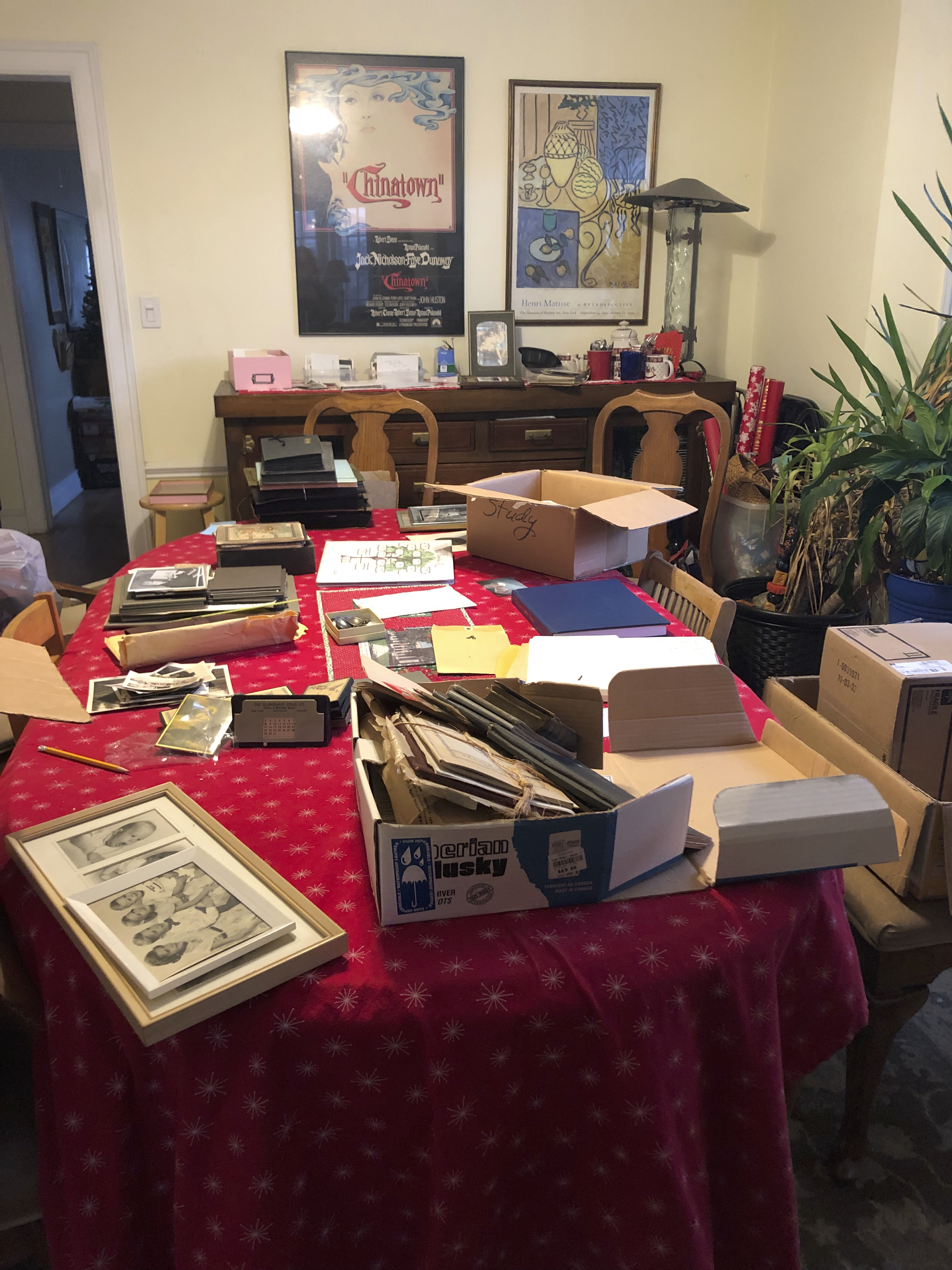
Forgotten, like a dream? Not exactly. My ancestors are currently all over my dining room. Photos, postcards, recital programs, newspaper clippings, letters -- half a dozen boxes of these came down from the attic earlier this week to be shared with my sisters and cousins at a day-after-Christmas brunch. My paternal grandmother, Esther Sieving Gotsch, in her later years, as her independence faded, saw to it that a lot of this stuff landed at my parents' house. When my mother moved out of this house in 2002, 18 years after my dad's death, it ended up in my attic because a) I'm a saver and b) I'm the one in the family whose house has an attic.

Her son, my dad, was no mean saver himself. He kept copies of every recital he ever played -- and not just one or two. After the post-performance congratulatory conversations and the standing around and talking with old friends (I'm thinking of you, today, Len Berghaus), he'd grab a handful of leftover programs and drop them in his briefcase before leaving church. Though not very tall, he had hands and fingers that could comfortably stretch from the root of a chord to the tenth above (that's ten white keys on the keyboard). A handful of programs was 25 or 30 copies. When my sisters and I emptied the rickety wooden file cabinet on the front porch of my parents' home where they were kept, we winnowed the number down to two or three copies of each program. And yes, they're in a box in my attic.

The boxes from my grandmother contain lots of old photos. Grandma Gotsch wrote names on the backs of some of them -- enough of them to be a guide to the unlabeled pictures. One photo album contains little notes on blue paper in my handwriting. I must have looked through the album with Grandma or her sister Clara before they died. If I have any memory of this, it is the vaguest of memories, recovered only because of those bits of blue paper.

Esther was the youngest of five sisters. It is not easy to tell them apart when they are clustered around their mother in tiny, hundred-year-old snapshots. It's even harder to know who is who when you have just one or two seated blurrily together on a bluff at Starved Rock or Devil's Lake, and the face you're not sure about may not even belong not to a Sieving sister. It may be one of those names you heard talked about at Christmas dinners --Donnenfeldts, Molzahns -- when the meal was over and you wanted your freedom. 

My grandmother and her sisters were the second family of Pastor Herman Sieving, who married my great-grandmother, Hattie Träbing, a few years after his first wife died. She was 24; he was 43. They moved from Ottawa, Illinois, from the church where he had confirmed her, to York Center (now Lombard) where he became pastor at Trinity Lutheran Church at the corner of Roosevelt and Meyers Road. Herman Sieving died of a heart attack on a Sunday afternoon in 1901, found dead in the orchard by the congregation's treasurer, coming to bring him his paycheck. My grandmother was two years old, her oldest sister, Dora, just 14. Hattie was 39, with hard years ahead of her.

Hattie and Herman Sieving outside the York Center parsonage

A year or two after her husband's death, Hattie moved her family from York Center to a small rented house near the railroad in Forest Park. She worked as a seamstress, as a teacher, I don't know what else. Her daughters worked as they became old enough, and in 1920, financially secure, they bought a house further south in Forest Park. In 1958, when I was 4, my parents bought the house next door. The great-aunts, Emma (my grand-mother's half-sister), Lydia and especially Clara, were a big part of my growing-up years. 

They were known as "the girls," these residents of the house at 612 Beloit. My grandmother was the only one who married and she lived with her husband less than a mile away in Oak Park, in a house that was eventually enlarged and shared with her daughter, her daughter's husband and their four children.

The stories that my generation knows of these women barely appear in their photos. Amanda died in February 1922, age 32, in a state mental institution. Fifty or sixty years later Clara told me how she had threatened her mother with a butcher knife and how the pastor came to the house and told her that her daughter had to be institutionalized. Men of the congregation took Amanda to the hospital in Joliet. Dora died in November 1925, age 38, of TB, I believe. My father told me once that Dora's illness, which must have begun years earlier, was the reason his mother did not go teachers' college like her next older sister. The family needed her to go to work right after she left high school, because Dora was sick. Grandma's high school yearbook, the commencement program, a formal high school graduation portrait -- we have these things yet. Esther's disappointment -- there's no record of that, though Daddy attributed late-in-life quarrels between the sisters to Grandma's resentment of Clara receiving educational opportunities denied to her. 

I look at all these photos and imagine other stories, just from the photos' existence, from someone's decision to dress up the subjects and get their photos taken. There are baby portraits of each daughter at about four months of age, plump, well-fed infants dressed in fussy late-19th century dresses. There's more than one copy of each of these portraits; in the 1880s and 90s it seems that parents, just like today, ended up with more copies of a photo than could be given away, more than could be put in the garbage. Names are penciled on the back of at least one copy of each photo by someone who knew who was who, probably my grandmother, who in her old age, worried about who would hang onto all this family lore. Maybe she learned about each picture from her own mother, who packed them up and kept them as she moved first from the York Center parsonage to a house that someone in the congregation allowed them to live in and then to the house in Forest Park. There are confirmation portraits of each girl as well, in white dresses with corsages pinned on their shoulders. Esther has long hair coiling down over her other shoulder to her waist. 

There's another rather romantic portrait of Esther, sitting at a piano, turning to face the camera. There's the same coil of long hair. You also see a love of music, immersion in music, and aspiration, borne out a generation later in my dad's high school piano recitals and his career as an organist.

The attic boxes also hold thick photo albums with snapshots from travels, for example, a trip down the Mississippi for Mother and the girls, with stops in St. Louis and at the Shiloh battlefield. One page holds three photos labeled "roustabouts playing craps" and opposite it, photos of black dock workers unloading a boat. Curious. It was 1920 -- a time closer to the Civil War than we are today to World War II. 

There are photos from my grandmother's wedding, multiple copies in cardboard folders suitable for display.  Esther wears a beautiful tea-length dress with a floor-length train and elaborate veiling gathered around her face and pooled at her feet. One feels the full gathered female culture of mother and sisters in these these elegant photos. Meanwhile, Grandpa Gotsch looks great in a tux. He stands very straight and and the trousers break at just the right point over his shoes.

I could go on and on, and perhaps I should. Perhaps my own descendants will be interested and will read my blog someday.

Anyway -- all this stuff is all over my dining room. We unpacked boxes rather randomly on Monday; I'm trying to pack them back up in better order and add clues for the future. (My sister Linda used the zoom on her phone's camera to locate our dad in photos from his grade school, high school and college bands. She wrote notes on the back, like "Second row from left, between the tubas.") There are many random snapshots from the 1950s, when my generation was born. Many of these are from shared Christmas celebrations. As we kids looked at them together we remembered the patterns on the carpets, the special dolls, the hand-me-down dresses that appear from Christmas to Christmas on one girl after another -- clues to which year, which house, what our parents' lives were like. I should write our names on the backs before I put them back into their boxes. 

Time, you know, bears us all away.