Sunday, January 01, 2023

Time

Standing, Emma, Dora, Hattie, Lydia, Amanda; kneeling, Clara, Esther.
 

Time like an ever-rolling stream 
soon bears us all away.
We fly forgotten as a dream
dies at the opening day. 
--- stanza from "Our God, Our Help in Ages Past"

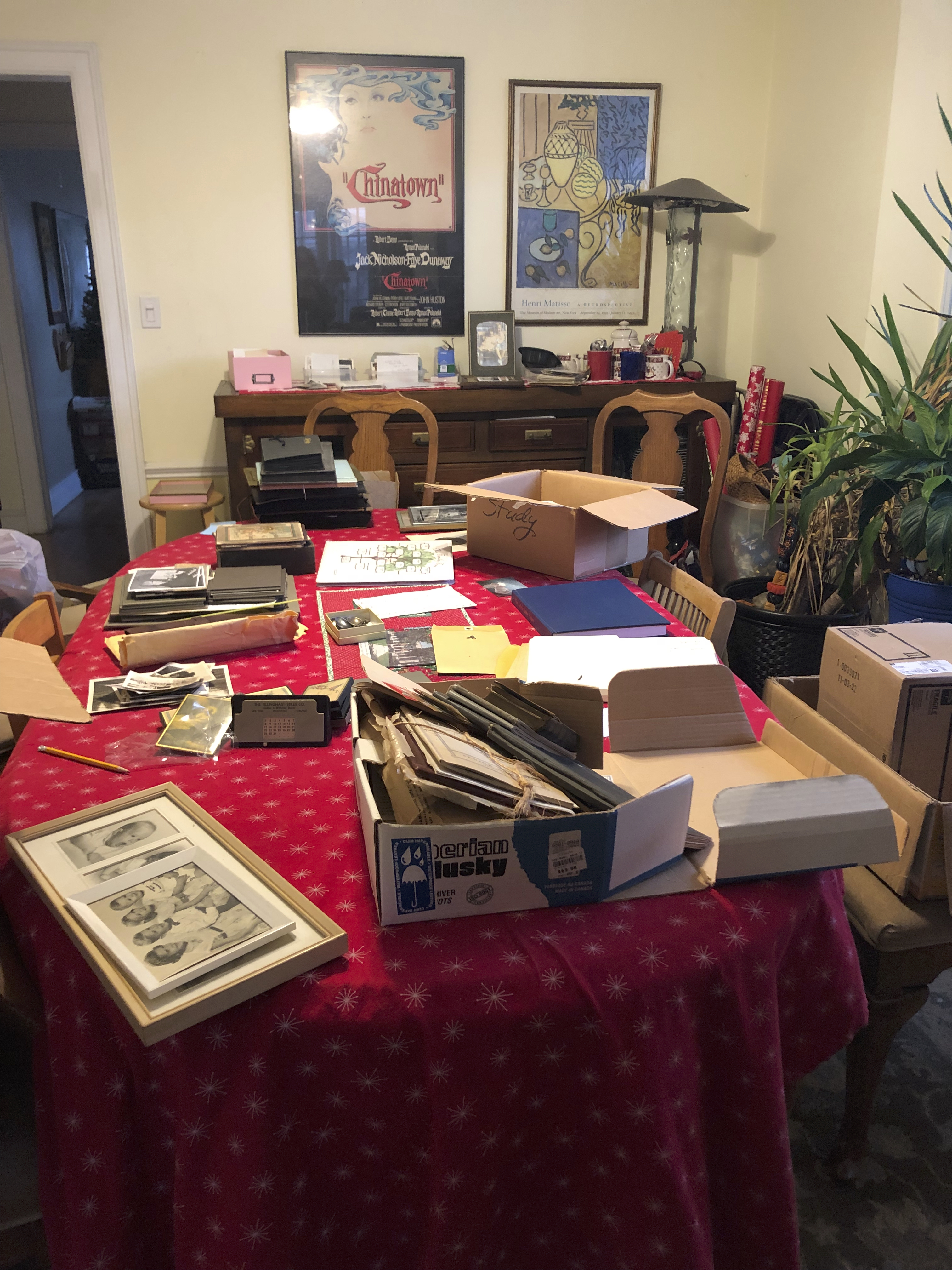
Forgotten, like a dream? Not exactly. My ancestors are currently all over my dining room. Photos, postcards, recital programs, newspaper clippings, letters -- half a dozen boxes of these came down from the attic earlier this week to be shared with my sisters and cousins at a day-after-Christmas brunch. My paternal grandmother, Esther Sieving Gotsch, in her later years, as her independence faded, saw to it that a lot of this stuff landed at my parents' house. When my mother moved out of this house in 2002, 18 years after my dad's death, it ended up in my attic because a) I'm a saver and b) I'm the one in the family whose house has an attic.

Her son, my dad, was no mean saver himself. He kept copies of every recital he ever played -- and not just one or two. After the post-performance congratulatory conversations and the standing around and talking with old friends (I'm thinking of you, today, Len Berghaus), he'd grab a handful of leftover programs and drop them in his briefcase before leaving church. Though not very tall, he had hands and fingers that could comfortably stretch from the root of a chord to the tenth above (that's ten white keys on the keyboard). A handful of programs was 25 or 30 copies. When my sisters and I emptied the rickety wooden file cabinet on the front porch of my parents' home where they were kept, we winnowed the number down to two or three copies of each program. And yes, they're in a box in my attic.

The boxes from my grandmother contain lots of old photos. Grandma Gotsch wrote names on the backs of some of them -- enough of them to be a guide to the unlabeled pictures. One photo album contains little notes on blue paper in my handwriting. I must have looked through the album with Grandma or her sister Clara before they died. If I have any memory of this, it is the vaguest of memories, recovered only because of those bits of blue paper.

Esther was the youngest of five sisters. It is not easy to tell them apart when they are clustered around their mother in tiny, hundred-year-old snapshots. It's even harder to know who is who when you have just one or two seated blurrily together on a bluff at Starved Rock or Devil's Lake, and the face you're not sure about may not even belong not to a Sieving sister. It may be one of those names you heard talked about at Christmas dinners --Donnenfeldts, Molzahns -- when the meal was over and you wanted your freedom. 

My grandmother and her sisters were the second family of Pastor Herman Sieving, who married my great-grandmother, Hattie Träbing, a few years after his first wife died. She was 24; he was 43. They moved from Ottawa, Illinois, from the church where he had confirmed her, to York Center (now Lombard) where he became pastor at Trinity Lutheran Church at the corner of Roosevelt and Meyers Road. Herman Sieving died of a heart attack on a Sunday afternoon in 1901, found dead in the orchard by the congregation's treasurer, coming to bring him his paycheck. My grandmother was two years old, her oldest sister, Dora, just 14. Hattie was 39, with hard years ahead of her.

Hattie and Herman Sieving outside the York Center parsonage

A year or two after her husband's death, Hattie moved her family from York Center to a small rented house near the railroad in Forest Park. She worked as a seamstress, as a teacher, I don't know what else. Her daughters worked as they became old enough, and in 1920, financially secure, they bought a house further south in Forest Park. In 1958, when I was 4, my parents bought the house next door. The great-aunts, Emma (my grand-mother's half-sister), Lydia and especially Clara, were a big part of my growing-up years. 

They were known as "the girls," these residents of the house at 612 Beloit. My grandmother was the only one who married and she lived with her husband less than a mile away in Oak Park, in a house that was eventually enlarged and shared with her daughter, her daughter's husband and their four children.

The stories that my generation knows of these women barely appear in their photos. Amanda died in February 1922, age 32, in a state mental institution. Fifty or sixty years later Clara told me how she had threatened her mother with a butcher knife and how the pastor came to the house and told her that her daughter had to be institutionalized. Men of the congregation took Amanda to the hospital in Joliet. Dora died in November 1925, age 38, of TB, I believe. My father told me once that Dora's illness, which must have begun years earlier, was the reason his mother did not go teachers' college like her next older sister. The family needed her to go to work right after she left high school, because Dora was sick. Grandma's high school yearbook, the commencement program, a formal high school graduation portrait -- we have these things yet. Esther's disappointment -- there's no record of that, though Daddy attributed late-in-life quarrels between the sisters to Grandma's resentment of Clara receiving educational opportunities denied to her. 

I look at all these photos and imagine other stories, just from the photos' existence, from someone's decision to dress up the subjects and get their photos taken. There are baby portraits of each daughter at about four months of age, plump, well-fed infants dressed in fussy late-19th century dresses. There's more than one copy of each of these portraits; in the 1880s and 90s it seems that parents, just like today, ended up with more copies of a photo than could be given away, more than could be put in the garbage. Names are penciled on the back of at least one copy of each photo by someone who knew who was who, probably my grandmother, who in her old age, worried about who would hang onto all this family lore. Maybe she learned about each picture from her own mother, who packed them up and kept them as she moved first from the York Center parsonage to a house that someone in the congregation allowed them to live in and then to the house in Forest Park. There are confirmation portraits of each girl as well, in white dresses with corsages pinned on their shoulders. Esther has long hair coiling down over her other shoulder to her waist. 

There's another rather romantic portrait of Esther, sitting at a piano, turning to face the camera. There's the same coil of long hair. You also see a love of music, immersion in music, and aspiration, borne out a generation later in my dad's high school piano recitals and his career as an organist.

The attic boxes also hold thick photo albums with snapshots from travels, for example, a trip down the Mississippi for Mother and the girls, with stops in St. Louis and at the Shiloh battlefield. One page holds three photos labeled "roustabouts playing craps" and opposite it, photos of black dock workers unloading a boat. Curious. It was 1920 -- a time closer to the Civil War than we are today to World War II. 

There are photos from my grandmother's wedding, multiple copies in cardboard folders suitable for display.  Esther wears a beautiful tea-length dress with a floor-length train and elaborate veiling gathered around her face and pooled at her feet. One feels the full gathered female culture of mother and sisters in these these elegant photos. Meanwhile, Grandpa Gotsch looks great in a tux. He stands very straight and and the trousers break at just the right point over his shoes.

I could go on and on, and perhaps I should. Perhaps my own descendants will be interested and will read my blog someday.

Anyway -- all this stuff is all over my dining room. We unpacked boxes rather randomly on Monday; I'm trying to pack them back up in better order and add clues for the future. (My sister Linda used the zoom on her phone's camera to locate our dad in photos from his grade school, high school and college bands. She wrote notes on the back, like "Second row from left, between the tubas.") There are many random snapshots from the 1950s, when my generation was born. Many of these are from shared Christmas celebrations. As we kids looked at them together we remembered the patterns on the carpets, the special dolls, the hand-me-down dresses that appear from Christmas to Christmas on one girl after another -- clues to which year, which house, what our parents' lives were like. I should write our names on the backs before I put them back into their boxes. 

Time, you know, bears us all away.  


Saturday, December 24, 2022

Christmas Eve 2022

"Enjoy the darkness."  

We'd done legs-up-the-wall, Downward-Facing Dog, lunges, Warrior 2, Warrior 1, and even a sort-of-half-handstand supported by the wall. It was late-afternoon yoga in mid-December. As I'd come into class, the instructor asked (as yoga instructors do), was there anything in particular I needed today, anything I needed to work on? 

"Slow me down," I said. As usual, I'd rushed to get there. 

"Mentally or physically?" she asked. 

"My brain," I said. "It's so busy."

I rolled out my mat by a corner of the wall, collected a blanket and blocks from the shelves at the back of the room. Five or ten minutes of quiet rest with my legs up in the air, supported by the wall, slowed me down, as did the deliberate practice that followed. 

Yoga classes end with Shavasana, also known as Corpse Pose, where you lie still on your back, relax, and let go. The lights are dimmed and the almost-darkness of the room is comforting and enfolding, something to enjoy, like sleep, but aware.

In these days around the December solstice and Christmas, darkness is everywhere. The house is dark in the morning when I get up. Darkness shows up in the afternoon before 5 p.m. We had a stretch of rainy, gray December days last week where even at mid-day I found myself starting conversations with "It's so dark." In these final days before Christmas 2022, extreme weather is a reminder that winter can be dangerous as well as dark.

But there's light, too. Lights on the Christmas tree. Lights up and down the streets, brighter than used to be thanks to LED bulbs. 

In the last two weeks I've spent time working with the 8th graders who are reading the scripture lessons this evening at the Children's Service of Lessons and Carols at my church. I make sure they understand what they're reading and help them share it out into the congregation. Mostly I remind them to slow down and look up occasionally. Their bright faces will reflect the wonder of this night.  

Contrasts between light and darkness show up often in these Christmastide lessons read year after year. Isaiah prophesies that "the people who walked in darkness have seen a great light." In a reading from Genesis 22 God directs faithful Abraham to consider the stars in the heaven; his descendants will be that numerous. There's the "glory of the Lord" shining around the shepherds as the angel announced Christ's birth over the fields of Bethlehem. There's the light of the star that led the wise men to the unexpected birthplace of the new child king. 

The final lesson, a grand theological summation, is John, chapter 1: 

What has come into being in him was life, and the life was the light of all people. The light shines in the darkness, and the darkness did not overtake it. (v. 5-6)

Life, light, glory and good news -- memorable images, all good things. 

But what about the darkness? 


Consider the darkness of the manger. My oh-so-Lutheran book group celebrated Christmas last weekend by gathering to read out loud from "Martin Luther's Christmas Book," a collection of excerpts from the reformer's 16th-century Christmas sermons. As he told the Christmas story from the pulpit, he added lifelike details from his own imagination to help his listeners enter the story and have a more intimate encounter with God made human. Mary, he emphasized, gave birth in the dark, with only Joseph to attend her. No water, no light, no midwife. No carefully prepared baby clothes, no place to lay the infant but a manger -- and that manger was in a very dark stable.

Luther's age experienced darkness more directly than we 21st century city-dwellers do. Street lights and headlights light up the roads in front of us, and flashlights on our phones show us where to walk on the way to the bathroom at the campground. We have to drive far out into the country to find the darkness that makes it possible to see the multitude of stars that Abraham saw. We aren't directly acquainted with moonlight nor its absence when the moon is new and all the landscape is in shadow.

But we do know of dark times—metaphorical darkness, times of spiritual struggle, grief, and depression when we are afraid because we are not sure about what's in front of us. Dark in this sense, however, has become a word to use with caution. Blame Jung, blame "Star Wars," blame Christianity -- dark is often used as a metaphor for evil and and has been used as a racist tool for instilling a sense of inferiority in people of color. We could banish the word dark (and perhaps should banish some usages), but that won't make our fears of the unknown go away.  Meanwhile, as Barbara Brown Taylor writes in Learning to Walk in the Darkness,  we miss a lot of truth if we look for God only in the bright and shiny things. 

Christmas Eve brings us to the darkness of the manger where the newborn Jesus emerged from the darkness of Mary's womb into a still-dark place. But in this dark world he was held and supported in Joseph's calloused hands, settled against Mary's softening belly, wrapped firmly and securely in swaddling bands, and laid in a rustic but sturdy trough for feeding animals. Human parents did the best they could for their God-made-human infant. And Mary pondered all the things that happened that night in her heart for a long, long time and recalled them weeping when they laid Jesus in the tomb following his crucifixion.

The list of people I know going through dark times seems longer than usual this December. Perhaps that's because I'm getting older. I've typed "you're in my prayers" into Facebook messages, emails and texts too many times in the last few weeks and felt the dim insufficiency of the message. Really, when are people not being hit hard by loss, grief, illness, failure, days of reckoning? 

The first Christmas in my life that was like this was in 1983, when my 57-year-old father was diagnosed with a brain tumor that would take his life well before spring appeared. One of his gifts to me during that dark time was a closer acquaintance with Paul Gerhardt's hymn "Once Again This Night My Heart Rejoices." There are many stanzas, most of which no longer appear in Lutheran hymnals. But this is the relevant one:

Hark! a voice from yonder manger, 
Soft and sweet, doth entreat, 
"Flee from woe and danger;
Come and see, from all that grieves you
You are freed; all you need
I will surely give you."

I was young then and in the year that I grieved for my father, I looked for an end to the darkness, the time when I would emerge again happily into the light and return to a life disturbed only by more quotidian problems. 

But if you follow Luther's imagination, his story-telling, you have to picture that voice promising freedom is coming from a dark manger. To come and worship the child who lives there means entering that darkness, not sure of where to put your feet, not sure if there's clean straw where you'll kneel. You're trusting a voice you can't see; it's a baby, a voice you can't understand except on the most basic level of wired-in empathic responses to newborn cries and needs. 

I've been working on this blog post for ten days now, wondering where it would end up, trying to make it come out some place where "enjoy the darkness" would make some kind of sense. It's 5:45pm on Christmas Eve; the darkness has fallen here in Illinois and a beautiful choral arrangement of "Silent Night" is playing on Spotify. The setting is right, but much as I feel this blog post should arrive at a satisfying ending tonight (like a Hallmark Christmas movie), I don't have one. 

It's Christmas Eve. It's dark. It's unknown. But God is here—whether it's in the eyes-closed Shivasana, Corpse Pose, of yoga practice, in eyes-closed prayer for others, or in very personal encounters with grief, sorrow, death and dying this Christmas tide. 

May you find all you need in the Christ Child this Christmas.


Saturday, December 03, 2022

Feeling conscious


This week I read a little book by Antonio Damasio titled "Feeling and Knowing: Making Minds Conscious." Damasio is a prominent neuroscientist and author. "Self Comes to Mind: Constructing the Conscious Brain" is another of his books; you get the idea. He's an atheist, interested in explaining consciousness in materialist terms. (Materialist: a person who supports the theory that nothing exists except matter and its movements and modifications.)

A dozen or more years ago I read part of an earlier book by Dams -- I think it was "Descartes' Error: Emotion, Reason, and the Human Brain." I gave up before finishing it. It seems to me that he defines his way toward explanations. If you define things a certain way, you can build them into a theory of how it all works, but this means you have to keep those specific definitions in mind as you struggle onward through the text. Since the words he defines are ones that are used broadly in non-scientific contexts (i.e., mind, emotion, conscious) you have to keep reminding yourself of the narrowness of the terminology as you read. You also encounter names for regions in the brain, which are unfamiliar to me. The science of consciousness comes out of knowing something about what kind of information each of these areas process and how they interact. I was reading this earlier book at night. There was more falling asleep going on than there was  comprehending, and eventually I gave up. 

"Feeling and Knowing" was on the new book shelf at the library. It is literally a little book, small in format. Though it's more than 200 pages, the chapters are short and there's plenty of white space where one chapter ends and the next begins. It seemed readable. In the intro, "Before We Begin," Damasio explains that this book chips away at all the "connective tissue and scaffolding" of earlier, longer writings to present the ideas he most cares about in concentrated form, like poetry. 

So it was an easier read, 20 or 30 minutes in the morning for several days. It reads more like philosophy than science, so it seemed an appropriate book for a time of day when I often read something spiritual or devotional. I put enough effort and intention into reading that I feel it merits a book report, to challenge me to put this all in my own words as a check on whether I understood what I read. 

Basically, says Damasio (I think!) minds become conscious when they recognize themselves as the ones doing a thing or having a perception. They can do this because feelings that originate in an organism's nervous system connect body to brain and, importantly, brain back to body.  In the 17th century Descartes said, "I think, therefore I am." Damasio's version is "I feel, therefore I am." 

Okay, that's grossly over-simplified. You need a longer and more exacting discussion of what feeling is in neuro-scientific terms before you use it in a materialist understanding of consciousness. Feeling arises in the nervous system, which is the body keeping track of itself. The nervous system has millions of cells and sends billions of messages to itself about feeling. There's a distinction between perceptions of the sensory system and information recorded by the nervous system in feeling. Sight, hearing, and touch perceive things that are outside the body and independent of it. Feeling is the body interacting with itself and thus aware of itself, aware of being in the world. 

As I read I thought back to being a young child in the dark, confined to bed because, you know, bedtime, but unable to fall asleep as quickly as my sisters in the same room. With nothing to hear, nothing to look at (and no reading lamp next to my bed at that age), I would start to wonder who or what I was. Was if I was a machine or a robot in the middle of a world inhabited by some other kind of creatures, who were not machines? Who or what was living in my interior world? Funny, at age six or seven I didn't wonder about how the world looked to other people, to other children my age. I was conscious of my own singularity. I assumed I was a one-of-a-kind consciousness. Maybe I didn't yet have the necessary neurons or the necessary experience encoded in neurons to think about other people being conscious in the world. Even now, it doesn't come naturally. I have to step on the brakes, put my hands on the steering wheel, and maybe turn on the headlights before my brain can see through another person's windshield. 

Bessel Van Der Volk's book The Body Keeps the Score fits into this world of feeling and knowing, as it details how the nervous system records experience as feeling and how feeling and knowing are more than verbal, conscious exercises. If you've had the experience of grief unexpectedly welling up in your gut or your tear ducts, you know this, just as you might know it from the feeling of wordless awe, even joy, you experience when you see the colors of a sunset or the majesty of a mountain. A pile-up of feelings produces how we react to all kinds of things, and it takes some introspection to pick that all apart and understand it. 

Words are helpful. Just like money. They turn values into currency to exchange with others and use for our own planning purposes.

This is  The Perverse Lutheran blog, so I can't very well finish without talking about the traditional Christian concept of a human soul and of God. These don't have a place in Damasio's materialist world, and I confess, I don't know what they mean in my world. That Gwen-child becoming aware of her own consciousness had already had plenty of religious training; naming the mystery of it all "God" made it scarier. I could take the creationist view and say, yes, science is great, but with the complexity of it all, the many remaining unknowns -- well, you need God to explain all that. But jumping from science to superstition seems to easy. It shorts the circuits. 

So I'm left wondering, awed, brain exercised, on a bright Saturday morning. Feeling, thinking, knowing -- I still have to load the dishwasher, find a tablecloth, maybe bring down some Christmas decorations from the attic. Consciousness getting real and changing the input it's getting from my surroundings. 

Thursday, November 24, 2022

Thankful


Driving to church this morning, I saw a squirrel run across the street. It ran right at the car in front of me and I thought for sure it was doomed. I was already picturing the splat of squirrel on pavement. But no -- it hit the car, or the car hit it, or maybe it didn't hit the car at all. What it did do was a perfect backflip, impressive height, stuck the landing, and kept right on going, straight to the other side of the street.

It all happened right there before my eyes. So I began Thanksgiving Day 2022 thankful for bounce and resilience. What other things are there to be thankful for today? What special things, what everyday things? What things that are not things but still gifts? 

Here are some thoughts. (You think, too -- it's good practice.)


Things I'm thankful for this evening.

Yesterday's wifi repair. Yes, it sounds shallow, but I truly missed Alexa. She's back. She tells me the weather. She plays NPR, and sleep music, too.

Brunch, today's alternative to a big family dinner. More and better conversation when there's just four people and you're not trying to serve a dozen dishes hot.

Wool for knitting, wool for weaving, and all the things you can make it do with looms and needles. 

Heat. Light. Water. Available just by flicking a switch or turning a faucet. I can't imagine what life is like for the people of Ukraine. 

Singing, with people my own age and with younger ones who keep me sharp. Not literally sharp, but sharp enough not to be flat. 

The good and interesting books I've read this year. Someday I'll keep a list so that I can trot out a list of recommendations. Good as they were, the titles mostly elude me in the moment. Maybe they weren't so good after all.

The less-good and the mundane books in my life this year. Ordinary is not a terrible place to spend time.

Lavender hand lotion. Good for rubbing on your feet before going to sleep.

Salmon fillets, which are, praise be, among my daughter's favorite foods. 

Kurt, my thirty-year-old son. How is it that my youngest child is that old and yet is wise beyond those years? (He is still a lovable goof, too.)

Eliza, my soon-to-be thirty-two-year-old daughter. Also wise beyond my expectations.

I'm thankful for living and breathing today. For bouncing along on the surface of life, for being pulled under into dim and confusing places, for all the details that I turn over endlessly in my brain and for the mind that does that work, consciously and unconsciously.

I'm thankful for poetry that turns words and phrases sideways to catch and hold unique moments in time. I'm thankful for the times I've been able to do that myself and thankful for times when I try to sit with the present moment and not much of anything shows up. 

I'm thankful for people who read this blog. 

I'm thankful for grief and all the people who illuminate it, especially in Anderson Cooper's podcast "All There Is."

I'm thankful for the exercise that got my knee back into shape after I fractured my patella. Thankful for the calm and alignment of yoga. Thankful for the nap I'm drifting towards.


It's dark. It's chilly in the house. It's time this weekend to get out the Advent candles and gird ourselves for the cold winter. Nothing else to do but head on through it, thankful for all that life brings and all the ways we avoid going splat. We bounce. We turn back flips.


Wednesday, November 02, 2022

All Saints 2022: After the battle


I read three sermons yesterday on All Saints Day: Nadia Bolz-Weber's post "It's All Saints, Not Some Saints," preached in a women's prison last Sunday; and two sermons from 1969, one from my Grandpa Gotsch's funeral in June of that year and the other from the All Saints Day commemoration at Concordia College in River Forest the following November. The order of service at Concordia, where my dad taught organ, included my grandfather's name, Herbert Gotsch, Sr., on the list of family members of students and faculty who had died that year.

I found these 1969 sermons in my attic this fall, in a box of papers from my grandmother who saved everything. Because of poor health she was not able to attend my grandpa's funeral. Having a copy of the sermon to read and save would have brought some consolation. Pastor Paul (that was his last name — we didn't use first names with pastors in those days) preached on Psalm 23 which had been my grandfather's confirmation verse. 

Pastor Paul noted all the ways the Good Shepherd had cared for Herbert throughout his life. But he didn't mention my grandfather's service in the infantry in France in World War I, when he was a young man of 25. Yet if Herbert Gotsch (1892-1969) indeed had a Good Shepherd, that Good Shepherd must have been there in the trenches, too. Could that young man, taught by his parents to fear and trust in God, feel God's presence in France? Did it help? Did he despair? Friends said Herb was never the same after the war. Twenty years later, when my dad was still a child, he suffered a severe depression; my aunt, his daughter, told me of how he would lash out in anger at my grandmother. He became senile in his final years, fighting a losing battle with language and cognition and restlessness. 

Martin Koehneke, president of the college, preached the All Saints sermon in 1969. He quoted the battle language in the hymn "For All the Saints":

And when the fight is fierce, the warfare long/Steals on the ear the distant triumph song;

And hearts are brave again, and arms are strong. Alleluia! Alleluia!

The text of the hymn is from 1864, 30 years before Stephen Crane wrote about the reality of battle and cowardice in "The Red Badge of Courage" and more than a century before PTSD was added to the American Psychiatric Association's DSM. Post-Vietnam, post-20th century, we're less inclined to use war as a metaphor for the life of faith.

 Another stanza of the hymn also speaks of warriors: 

The golden evening brightens in the west. 
Soon, soon, to faithful warriors comes their rest.

While scuffling through the woods at the Morton Arboretum this morning, I received a text telling me of an old friend, Scott, for whom that rest arrived this morning. His death had been expected for the last few days, after a long, debilitating battle with cancer. 

These days we are careful not to say "lost his battle" with cancer or with ALS or with Alzheimer's. There is no losing a battle that is known to be un-winnable from the start. The suffering is fierce and long and tearful. It changes the ones who watch and care as well as those who are sick. Yet God is present as Good Shepherd, loving Savior, Comforter. "Sweet is the calm of Paradise the blest," continues the hymn, and that sweetness appears in God's everyday grace even on this side of the grave. 


It was a warm, dry day today. As I walked in the woods this morning I spent as much time looking down at the dry leaves underfoot as I did looking up at the blue sky and the gold and rusty leaves still on the trees. We sat for a while on a bench and watched leaves float down from treetops to the ground, yielding to gravity yet dancing little minuets in the air. 

In his 1969 sermon, Martin Koehneke preached about the spiritual victory of the saints in heaven and the song of the saints and angels in Revelation 7:12:

Amen! Blessing and glory and wisdom

and thanksgiving and honor

and power and might

be to our God forever and ever! Amen.

He found comfort for mourners in every word of the song and built a stirring finish for his sermon. I can imagine my father appreciating it. But to me -- what does this all mean? Maybe you had to be there. 

In the days after a death, when we're shaky and sorrowful, we often use very concrete images to describe that person's life in heaven, images that make us smile or even laugh. When my father died, there was lots of talk about him making music in heaven with J. S. Bach. My favorite variation came from a former organ student who described Daddy watching Bach play from one of his manuscripts. My dad reached into his pocket for his pen, leaned over Bach's shoulder, and wrote in some fingering. 

When I picture my son Kris in heaven, he's playing frisbee with his brother, Kurt, on the lawn at the Sunset Resort on Washington Island. It's the golden hour, about 45 minutes before the sun will set over the lake. The frisbee's in his right hand, he's a got a bottle of Island Wheat in his left, happy to be whole again, happy to be in the presence of God. 

Sunday, October 09, 2022

Grief

Grief is stored in the body. I could go off on a search for references, but I don't need psychologists or neuroscientists to confirm this for me. I know it, in my gut. Or is it my left lung? It's in the vacuum that opens up right beneath my heart when I swerve too close, too suddenly to a memory. It's a space that also opens in sympathy for others' grief. 

"Son and brother." These are the words that leapt into my mind in church today as I heard of the death of a close family member of people well known to me over the years. a death that followed a brutal and discouraging battle with cancer.  "Son and brother" also describes my son, Kris. The loss is five years old, but the wound still opens easily. Tears flow. 

I hate crying in church, or at least I say I do. The self-control needed to stop it relies heavily on anger or disassociation along with an assessment of what's needed from me in the next few minutes as a choir member. Today I could look forward to the trebles of the choir singing the third stanza of "Praise, My Soul, the King of Heaven." 

Tenderly he shields and spares us

Well our feeble frame he knows.

In his arms he gently bears us

Rescues us from all our foes. 

Not, but isn't it pretty to think so? 

And yet —in illness, death, sorrow and grieving we are gently borne along in God's arms. That is, of course, a metaphor, and I'm not sure that I can explain for what. A shrug here -- it's a mystery! Or it's something for the mystics. All things must die, yet God our Creator loves and cares for all and ultimately folds them into the Godhead, into wholeness, into resurrection

It was a beautiful fall day today, the kind where bright sunshine celebrates the first trees to turn gold, orange and deep scarlet. A month from now the leaves will be on the ground. I won't be able to sit in my backyard with an Oktoberfest beer from On Tour Brewing Company. It will be much colder. 

But even then there will be wholeness. Because wholeness includes grief and grieving, housed in that place in the gut that grieves as leaves fall from trees, that grieves with all who grieve today.

Sunday, September 25, 2022

Silence, after and before

 It's silent in my backyard, relatively speaking. There's the sound of a plane overhead. A car turns out of the alley to the north, and another drives past my yard and turns into the alley. There's the sound of traffic a block away, and more city noise further in the distance. No dogs, no people walking past. It's gone dark in the time I've been out here with my Oktoberfest beer, finishing a crossword puzzle before looking at the empty white space in a new blog post. 

It's silent—noticeably silent after a noisy afternoon of music: Vaughan William's Variations on a Theme by Thomas Tallis stretched and held, pushed forward and held back, shaping silence into human need and yearning. (Listen here.) The main event that followed was a Bach cantata (BWV 119)  with many, many four-trumpet fanfares lavishing praise on the people of Leipzig and their new town council. (Program notes here.) One has to admire the great man, who kept all this pompous flatter just this side of winking humor without tipping over from sincerity into satire. There were plenty of big finishes and more high As than I can remember in the hymn settings. (It is nice when the choir director smiles at the soprano section as we hold one of these high notes for a full measure or more. I know he's smiling to be encouraging because he thinks it will help the tuning,  but I do hope some percentage of the pleased look was genuine pleasure.) 

After that smashing late-afternoon hour and a half, the evening quiet and even the chill in the air are welcome. What is God speaking now?

A book I read recently spoke of all music beginning in silence. It was historical fiction about J. S. Bach and his family ("The Great Passion" by James Runcie), told through the voice of a student soloist in the choir. The remark about silence was attributed to Bach, who in this novel has to speak in sermons rather than melody and counterpoint. It seems like I read this remark somewhere else as well. I've fallen into a habit of reading two or three books at once, and sometimes the characters and/or the philosophy melt from one into the other. 

Does all music begin in silence? What does that mean? 

I guess there has to be silence before the music begins. I guess there has to be silence waiting to be broken by a tune or a fanfare. I guess silence — absence — calls, at least to some of us, for a statement. It's asking to be filled or pushed aside. Or we are compelled to separate ourselves from the silence and be noticed, heard. We need to be making something where there was nothing before. Like God at creation. Like a third-grade boy who can't sit still. Or me, who has opened up an empty white page in the blogging browser window not sure if she has anything to say.

When the music is over, the order imposed on the sound is let go, the ears stop ringing and the trumpeters and sopranos and the rest of the musicians go home to dinner and a nice glass of beer or whisky. 

Music ends in silence, though we are, most certainly, changed. As surely as God spoke, let there be light.


St. Nicholas Church in Leipzig where BWV 119 was first performed.