Sunday, October 28, 2012

Is it because I grew up with this that the air of late October seems especially thin to me and the saints seem especially present?


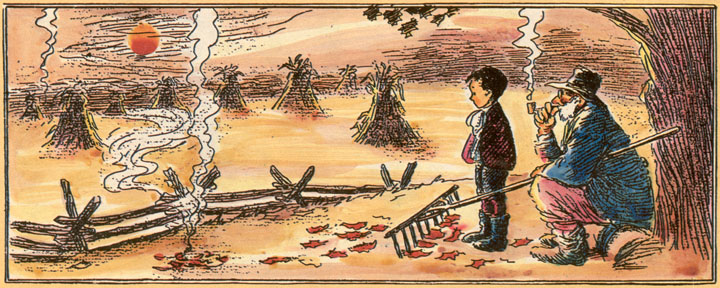
Yep, sonny this is sure enough Injun summer. Don't know what that is, I reckon, do you? Well, that's when all the homesick Injuns come back to play; You know, a long time ago, long afore yer granddaddy was born even, there used to be heaps of Injuns around here—thousands—millions, I reckon, far as that's concerned. Reg'lar sure 'nough Injuns—none o' yer cigar store Injuns, not much. They wuz all around here—right here where you're standin'. Don't be skeered—hain't none around here now, leastways no live ones. They been gone this many a year. They all went away and died, so they ain't no more left. But every year, 'long about now, they all come back, leastways their sperrits do. They're here now. You can see 'em off across the fields. Look real hard. See that kind o' hazy misty look out yonder? Well, them's Injuns—Injun sperrits marchin' along an' dancin' in the sunlight. That's what makes that kind o' haze that's everywhere—it's jest the sperrits of the Injuns all come back. They're all around us now.


"Injun Summer," two pictures and a little story appeared in the Chicago Tribune Sunday magazine in late October every year from 1907 through 1992. It's gone now, outlived its usefulness. I'm sure it's offensive to Native Americans--after all, it's wrong to say "they all went away died," when really they were pushed, cheated, manipulated, sickened and murdered by white European settlers.

But still--this piece captured my imagination when I was a child. I remember reading it out loud to myself and studying the similarities between the daytime picture above and the nighttime one.

.


When we sing of "mystic sweet communion with those whose rest is won," the music somehow connects saints on earth with saints in heaven. Or at least it feels that way. Someone more insistent than I on correct theology might locate that unity at the communion table, in the bread and wine becoming Christ's body and blood. But to me, music is as real as a wafer on the tongue or golden wine in a cup. And the tears that well up in the throat are sacramental, God embodied in our grief. Salty and substantial.

Wednesday, August 15, 2012

Island

Sunday evening, August 12

Twilight, which is about sky, high
above shadows, light beyond tears.

Water, which is no color at
all, reflecting sky, twilight sky.

I, in the shadows, with shallow
Breath, damp weight and wooly sweater.

Lift me to sky and I will sing.
Calm me as water, I will sleep.


Morning prayer

Morning sky, smooth and blue,
Make me more like you,
Clear and mild, like a child,
Trusting what is true.

Bugs and birds, gentle sound,
Heard, not to be found,
Chirping out, sing and shout,
God is all around.

Trees so tall and so old
Straight and bent have told
Reaching high into sky
Peace and calm enfold.

Water spread vast and wide
Touching sky on every side
Here on land, understand
I am mystified.

Saturday, July 07, 2012

Respiro, inspiro

Today--a day when I wish were Emily Dickenson, or was acquainted with her muse, or even better, had her craft in my own fingertips.

After days of oppressive heat that settled in the pores of arms and legs and wrapped bodies like mummies, closed in and fuming, there was a breeze this morning. I noticed it at midday, sitting outside stirring the ice in my plastic glass with my straw. The air was hot, but it was moving, going somewhere, past the trees, not bothering with bodies or walls, going onward. Still hot, but we were not pinned to our seats by warming degrees so high they defied records.

It is early evening now, and the breeze is cooling the air, the ground, the houses and the cars and the street. From time to time it swirls and grows into a wind, stronger with life of its own, but then it settles back down to take a rest. It will will find more energy in the coming dark and blow into a storm when I am safe under my own roof. Now robins and sparrows are twittering abstractions in the tops of the trees. Branches move with the gentle energy of the air.

Respiro, inspiro. Breathe. Inspire.

Oh, if I were Emily I could distill all this down into eight, or even four perfect metered lines of six or eight syllables, cryptic yet clear to those who crack the code. A single moving, changing image that inspires, that breathes with life.

Saturday, June 30, 2012

An die Musik

"I am going there to change my life."

This is what I said last week of my impending trip to Westminster Choir College and the week-long summer Conducting Institute. I said it with some measure of irony. It's a big statement, and what if I were to come back with my life not changed?

But I hoped.

I hoped, and here I am, at the end of the week, singing better, feeling free, exhaling as well as inhaling when I conduct. I've said hello to my past and reacquainted myself with the music inside me. I've heard other people's stories, told my own, and marveled at what music and truth and trust can do.

So that tomorrow I can go home and change my life.

Wednesday, June 27, 2012

Nänie

Day Three

We sang Nänie tonight, a Brahms setting of poem by Schiller.

The poem begins,"Auch das Schöne muß sterben!" Which means "Even the beautiful ones must die!"

Brahms was acquainted with the death of beautiful ones--Robert Schuman, other friends, Schiller himself. The music--why use words to describe it? You have to hear it, feel it lift in sadness, jab with anger, explore the size and weight of Brahms' grief. The gods weep and the goddesses. It is hard to bear--that people cease to be.

But at the end:

Auch ein Klaglied zu sein im Mundder Geliebten, ist herrlich,

Denn das Gemeine gebt Klanglos zum Orkus hinab.

Roughly,

Even a lament that is in the mouth of a loved one ist glorious,

Because the common ones go soundless into the abyss.

Remembering, grieving keeps something alive of the beautiful ones who are gone.

Day Two

(June 26, 2012)

Day Two at Westminster

In ten:

1. Sing with Sabine. Lift your leg to find those high easy overtones.

2. Breath with Nova Thomas. Opera lady--narrow black capris, wedgies, floaty purple top over an ample bosom. Dark eyes, expressive face. Jokes. Breath exercises. Breathing is so much easier than I thought.

3. Connections. In a circle breathing. In a circle conducting. I have the face that says hi, yes, I’ll talk to you, let’s do it together. (And then I have to stay friendly!)

4. Movement in three planes--really on three axes--table plane, door plane (verticals), and somersault plane (not its real name? but forward, backward, the third dimension)

5. Then freely moving. Like putting on my Sunday slip and dancing around the living room as a five-year-old.

6. Conducting--sucky me. Tired, concentration gone. Two-beat screwed up, and what about this shoulder tension? The ache? The tightness.

7. Lecture tonight on “body architecture” and I get my shoulder joint remapped. The ball and socket joint is in my armpit! Think the movement there, the pivot there, and the tight muscles I’m envisioning in the top of my shoulder go away. Throw in some wrist issues that I’m going to apply to computer ergonomics as well as conducting and I’d say that was a very good hour.

8. A “big walk” with my roommate from Beijing. Her arms swinging big, mine just comfortably, we wheel through downtown Princeton, free and talking and we didn’t get lost. Way more energy when I got back.

9. Which is a good thing because my watch is running out of energy and running slow and this is why I was late to Master Class today because the watch ran down. But by the time I figured out the watch was slow it was late afternoon and somehow I lost a half hour from my dinner break--at least in my head. Which may explain the late bedtime.

10. But before bed, and the final studying, I talked kids and music and opera and traded iTunes files with my new friend from China.

It’ll do, pig.

Weeping

(Monday, June 25)

So I’m at the Conducting Institute at Westminster Choir College. An hour of wonderful, relaxed vocalizing began the day, and then we started to sing through repertoire. A rainy Monday morning. Green summer, growing things, richness in the air.

The first piece of music—something simple: “Homeward Bound,” words and music by Marta Keen, arranged by Mack Wilberg. The text:

In the quiet misty morning
when the moon has gone to bed,
When the sparrows stop their singing
and the sky is clear and red,
When the summer’s ceased its gleaming,
when the corn is past its prime,
When adventure’s lost its meaning
I’ll be homeward bound in time.
Bind me not to the pasture;
Chain me not to the plow
Set me free to find my calling
And I’ll return to you somehow.

If you find it’s me you’re missing,
if you’re hoping I’ll return,
To your thoughts I’ll soon be list’ning . . .

Somewhere right about there I quit singing. An hour of playful vocalizing before the sightreading had left my throat, as singers say, open. So the tears could pour in, then rise to my eyes and stream down my face, as the music continued:

...in the road I’ll stop and turn.
Then the wind will set me racing
as my journey nears its end
And the path I’ll be retracing
when I’m homeward bound again.

It was Lon, my sainted husband, just there somehow on his own path. And it was children leaving home.

How does music do that? And so quickly, so effortlessly?

I cried like that once years ago, when Lon was lost in dementia and my life was constant stress. I went to yoga class, and lying on the mat, in those minutes of pre-class quiet, I let go and the tears ran down from the corners of my eyes, across my cheekbones, and, unpoetically, into my ears. No sobbing, no catching of the breath. And I couldn’t stop.

This morning I tried to get back into the music in order to stop crying, but it wasn’t going to happen. I could not govern my throat until we moved on to another piece of music.

Grief stays inside you, is you, is part of you for a long, long time. The waves of loss rise when their overtones sound. Like music.